
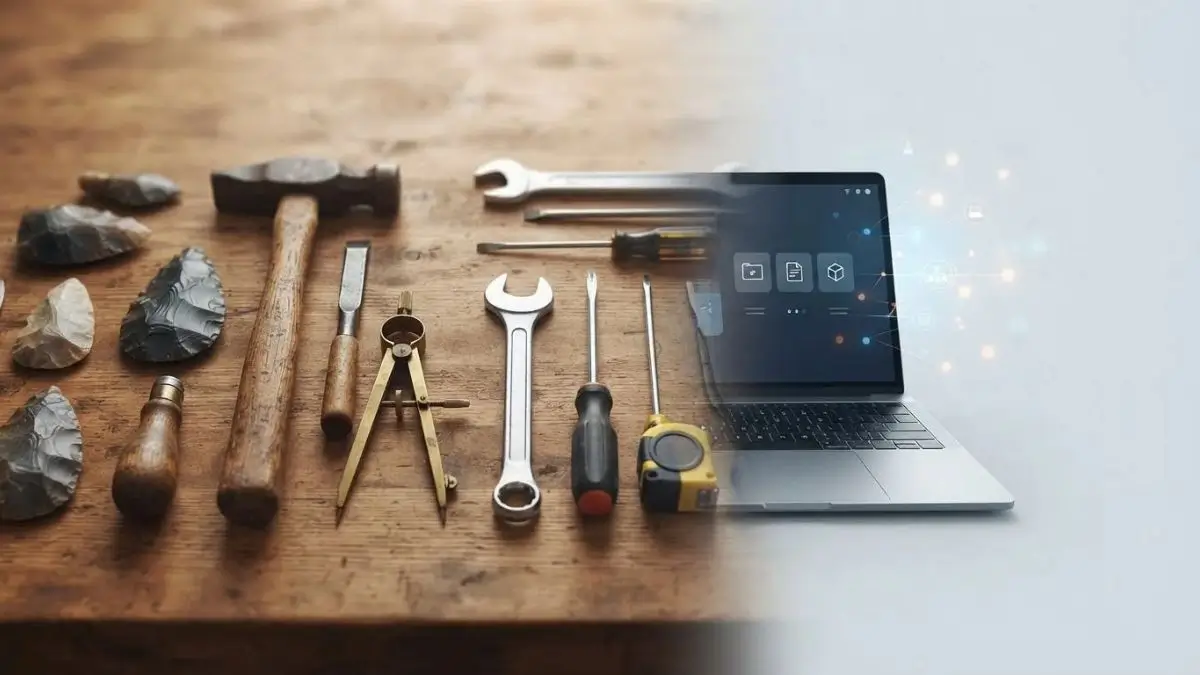
A tool is any physical object, device, or conceptual system used to extend an individual’s ability to modify their surrounding environment or accomplish a specific task. From the earliest chipped stones used by prehistoric hominins to the high-precision machine tools and digital software platforms of the modern era, tools have served as the primary driver of human survival, innovation, and civilization.
While human beings are unmatched in making and using tools—and remain the only species known to use tools to manufacture other tools—tool use is not exclusive to humanity. Across the animal kingdom, creatures from chimpanzees and sea otters to crows and octopuses rely on objects to gather food, build shelter, and defend themselves. Furthermore, in the modern world, the definition of a tool has expanded beyond physical hardware to include mental frameworks, analytical methods, and computer software.
This comprehensive guide explores the definition, history, classifications, functions, and broader impact of tools across human society and nature.
Defining What Makes a Tool
At its simplest, a tool is an unattached or manipulable object held and directed by a user to alter the form, position, or condition of another object more efficiently than the body could alone. Anthropologists and behavioral researchers generally distinguish a true tool from a fixed part of the environment by focusing on purposeful manipulation: the user must hold, carry, or orient the object toward a specific goal.
Unlike complex autonomous machines or computers that perform multiple automated functions independently, a traditional tool typically has a focused, hand-operated purpose. A hammer concentrates physical force onto a nail; a knife focuses pressure along a narrow blade to slice material; a ruler provides an external standard for measuring distance. Over time, however, the boundary between simple hand tools, power tools, and automated machinery has steadily evolved.
The History and Evolution of Tools
The story of human evolution is inseparable from the development of increasingly sophisticated tools. Anthropologists widely consider routine toolmaking one of the defining milestones in the emergence of modern humans.
1. Prehistoric Stone, Bone, and Wood Implements
Early hominins likely relied first on perishable materials such as wooden sticks or unmodified stones—objects virtually indistinguishable from natural debris in the archaeological record. However, intentional stone toolmaking dates back millions of years:
- Early Stone Cutting (3.4 to 2.5 Million Years Ago): Archaeological evidence from East Africa shows that early hominins used sharp stone flakes and Oldowan choppers to butcher carcasses, scrape hides, and process plant foods.
- The Hand Axe (1.6 Million Years Ago): The Acheulean hand axe introduced symmetrical shaping, demonstrating advanced planning and spatial awareness.
- Fire, Hunting, and Shelters: Between 1.5 million and 400,000 years ago, early humans mastered fire creation, built rudimentary huts, and crafted wooden javelins for hunting.
- Specialized Prehistoric Gear (200,000 to 10,000 Years Ago): Innovation accelerated rapidly with the invention of natural adhesives (glue), bone sewing needles, fishing nets, harpoons, bows and arrows, ropes, and fired ceramics.
2. Agriculture, Metallurgy, and Simple Machines
The dawn of agriculture around 4000 BC brought vital inventions like the wooden plough and the wheel, alongside the development of the six classic simple machines (lever, pulley, inclined plane, wedge, screw, and wheel and axle) in ancient Mesopotamia and Egypt. Concurrently, advancements in metallurgy shifted society from soft copper (c. 3200 BC) and bronze (c. 2500 BC) to durable iron and cast iron (c. 1500–400 BC), vastly improving cutting edges and structural strength.
3. The Industrial Revolution and Machine Tools
Prior to the 18th century, items were largely crafted by hand. The Industrial Revolution transformed production via power-driven machine tools—such as lathes, drill presses, and milling machines—inspired by clockmakers. These devices enabled the mass production of uniform, interchangeable metal parts that built modern infrastructure.
Major Categories and Types of Tools
Tools are categorized by their primary mechanical or informational function:
- Cutting & Edge Tools: Knives, axes, saws, and drills that shear materials.
- Moving & Torque Tools: Hammers, wrenches, and pliers that transfer linear or rotational force.
- Measuring & Guiding Tools: Rulers, levels, and microscopes that establish accuracy.
- Shaping & Forming Tools: Trowels, files, and anvils that mold or smooth.
- Fastening Tools: Welders, nail guns, and soldering irons that join materials.
- Thermal & Chemical Tools: Blowtorches, kilns, and burners that alter states via heat or chemicals.
- Information & Data Tools: Computers, code editors, and calculators that process abstract data.
(Protective gear like gloves and safety glasses are also essential workshop equipment.)
How Tools Function: Substitution and Multi-Use Design
- Substitution: Workers often practice makeshift substitution (e.g., using a flathead screwdriver as a pry bar) or rely on designed multi-purpose tools (such as handsaws with built-in 90-degree squares).
- Multi-Tools: Compact items like Swiss Army knives or folding hex-key sets integrate multiple instruments into a single portable frame.
Tool Use in the Animal Kingdom
Tool use is not strictly human:
- Primates: Chimpanzees use stick “fishing” tools and stone hammers to crack nuts.
- Birds: New Caledonian crows craft hooked twigs to extract insects.
- Marine Mammals: Sea otters use chest-resting rocks to open shells; bottlenose dolphins use marine sponges for foraging protection.
- Elephants & Octopuses: Elephants utilize branches and bark balls; veined octopuses build shelters out of discarded coconut shells.
Human tool use remains uniquely cumulative across generations.
Non-Material and Conceptual Tools
Beyond physical gear, “tools” encompass mental and digital frameworks:
- Cognitive & Professional Frameworks: Educational reflective tools or medical decision-making guides.
- Media & Digital Software: Telephones, search engines, and AI systems that extend human thought, aligning with Marshall McLuhan’s observation that “we shape our tools, and thereafter our tools shape us.”
Frequently Asked Questions (FAQs)
- What is the simplest definition of a tool? An object or software used to perform a task more efficiently than with the body alone.
- What were the very first tools? Sharp stone flakes and Oldowan choppers from 2.5 to 3.4 million years ago.
- What differentiates hand, power, and machine tools? Hand tools rely purely on muscle; power tools use external energy (electricity/air); machine tools are heavy, stationary industrial systems.
- Are humans the only tool-users? No, several animals use tools, though humans uniquely build tools to make other tools.


10 thoughts on “Tools”