
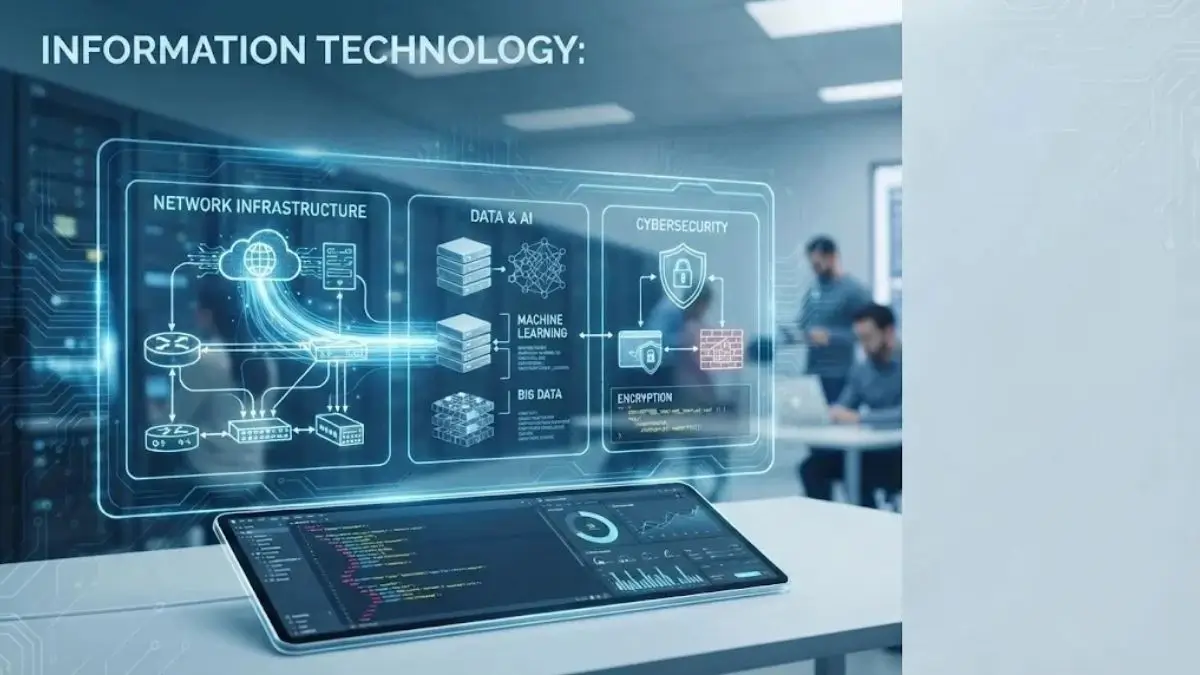
Information technology (IT) is the study, design, development, implementation, support, and management of computer-based information systems—encompassing both electronic hardware and software applications—used to create, process, store, secure, and exchange all forms of electronic data. Operating as the central nervous system of modern technology, information technology transforms raw binary data into actionable knowledge across business, healthcare, finance, scientific research, education, and government operations.
While closely related to computer science (which focuses on the theoretical foundations of computation and algorithm design), information technology emphasizes the practical deployment, integration, networking, and maintenance of computing infrastructure to solve real-world organizational and societal challenges.
Core Definition and Operational Scope
The term “information technology” gained widespread prominence following a 1958 Harvard Business Review article by Harold J. Leavitt and Thomas L. Whisler, who predicted that computer-driven data processing would reshape organizational management. Today, IT covers the complete lifecycle of digital information:
- Data Capture and Input: Collecting structured and unstructured records via keyboards, barcode scanners, biometric readers, and Internet of Things (IoT) sensors.
- Data Processing and Computation: Executing logical and mathematical operations on raw inputs using central processing units (CPUs), graphics processing units (GPUs), and enterprise software algorithms.
- Data Storage and Retrieval: Preserving digital assets reliably across local solid-state drives (SSDs), relational and non-relational databases, and distributed cloud computing data centers.
- Data Transmission and Networking: Moving packets of information securely between endpoints using wired and wireless communication protocols.
Historical Evolution of Information Technology
The progression of information technology spans four major technological eras, evolving from mechanical tabulators to globally interconnected cloud and artificial intelligence ecosystems.
Pre-Mechanical and Electromechanical Eras
Long before electronic computers, humans recorded and calculated information using abacuses, mechanical printing presses, and ledger books. In the late nineteenth century, Herman Hollerith invented electromechanical punched-card tabulating machines to process the 1890 U.S. Census, founding the company that later became IBM and establishing automated data processing.
Mainframe Computers and Early Enterprise Systems (1940s–1960s)
The invention of vacuum-tube and transistorized electronic computers—such as ENIAC and the UNIVAC I—enabled governments and large corporations to automate payroll, banking transactions, and scientific calculations. Room-sized mainframe computers centralized computing power, accessed by operators via punch cards and monochrome terminals.
The Microprocessor and Personal Computer Revolution (1970s–1980s)
The invention of the silicon microchip (integrated circuit) shrank computing components dramatically, giving rise to personal computers (PCs) from companies such as Apple, IBM, and Commodore. Paired with graphical user interfaces (GUIs) and office productivity software, PCs moved computing directly onto individual desks and created local area networks (LANs) inside offices.
The Internet, Cloud Computing, and AI Era (1990s–Present)
The commercialization of the World Wide Web in the 1990s linked isolated local networks into a single global information infrastructure. In the twenty-first century, smartphones, high-speed 5G cellular networks, cloud computing, and artificial intelligence shifted IT from locally maintained server rooms to on-demand, globally distributed platforms capable of real-time analytics and automation.
Six Pillars of Modern Information Technology Infrastructure
Enterprise and public IT ecosystems rely on six interdependent architectural pillars to function smoothly:
| IT Pillar | Core Function | Representative Technologies |
| Computer Hardware | Physical devices that execute computations and interface with users | Servers, workstations, laptops, smartphones, microchips, storage arrays |
| System & Application Software | Operating systems and programs that direct hardware and perform user tasks | Linux, Windows, macOS, ERP systems, CRM platforms, web browsers |
| Networking & Telecommunications | Infrastructure enabling devices to connect and exchange data | Routers, switches, fiber-optic cables, Wi-Fi, communication protocols (TCP/IP) |
| Databases & Data Management | Structured systems for storing, indexing, querying, and analyzing records | SQL (PostgreSQL, MySQL), NoSQL (MongoDB), data warehouses, big data pipelines |
| Cloud Computing & Virtualization | On-demand delivery of remote servers, storage, and software over the Internet | Infrastructure as a Service (IaaS), Platform as a Service (PaaS), containers (Docker) |
| Cybersecurity & Governance | Controls protecting systems and sensitive data from unauthorized access or loss | Firewalls, encryption (cryptography), identity management, zero-trust architecture |
Major Domains and Specializations in IT
Because modern digital systems span hardware, networks, software, and human workflows, information technology encompasses several specialized professional domains:
- Network and Systems Administration: Designing, configuring, and maintaining local and wide-area networks, servers, operating systems, and enterprise directory services to guarantee high uptime.
- Cybersecurity and Information Assurance: Defending digital infrastructure against malware, ransomware, phishing, and data breaches through threat monitoring, penetration testing, and cryptographic protocols.
- Database Administration and Data Engineering: Structuring high-availability databases, optimizing query performance, maintaining backups, and building pipelines for business intelligence and machine learning.
- Cloud Architecture and DevOps: Automating software deployment, continuous integration/continuous delivery (CI/CD), and scalable cloud infrastructure across hybrid and multi-cloud environments.
- IT Service Management (ITSM) and Technical Support: Aligning IT operations with organizational goals (using frameworks such as ITIL) and resolving hardware, software, and access issues for end users.
Impact of Information Technology Across Society
Information technology has fundamentally reshaped global productivity, communication, and access to knowledge:
- Business and Global Commerce: Enterprise Resource Planning (ERP), e-commerce platforms, digital supply chains, and electronic payment systems allow organizations to operate across continents in real time.
- Healthcare and Bioinformatics: Electronic Health Records (EHRs), telemedicine, medical imaging diagnostics, and genomic data analysis improve patient care accuracy and accelerate drug discovery.
- Education and Scientific Research: Digital libraries, remote learning platforms, and high-performance supercomputing simulations enable global collaboration and democratize access to educational resources.
- Governance and Public Services: Digital identity systems, e-government portals, smart traffic management, and emergency alert networks streamline civic administration and public safety.
Challenges and Future Frontiers in Information Technology
As society becomes increasingly dependent on digital infrastructure, information technology faces critical technical and ethical challenges:
- Cyber Threats and Digital Resilience: Rising sophistication of state-sponsored cyberattacks and ransomware demands resilient backup architectures, automated threat detection, and post-quantum cryptography.
- Data Privacy and Algorithmic Ethics: Collecting vast volumes of personal data requires strict compliance with privacy laws, transparent governance of artificial intelligence, and mitigation of algorithmic bias.
- Digital Divide and Sustainability: Bridging unequal access to high-speed Internet across developing regions while reducing the substantial electricity and water consumption of hyperscale AI data centers and mitigating electronic waste remain top priorities for future engineering design.


4 thoughts on “Information Technology”