
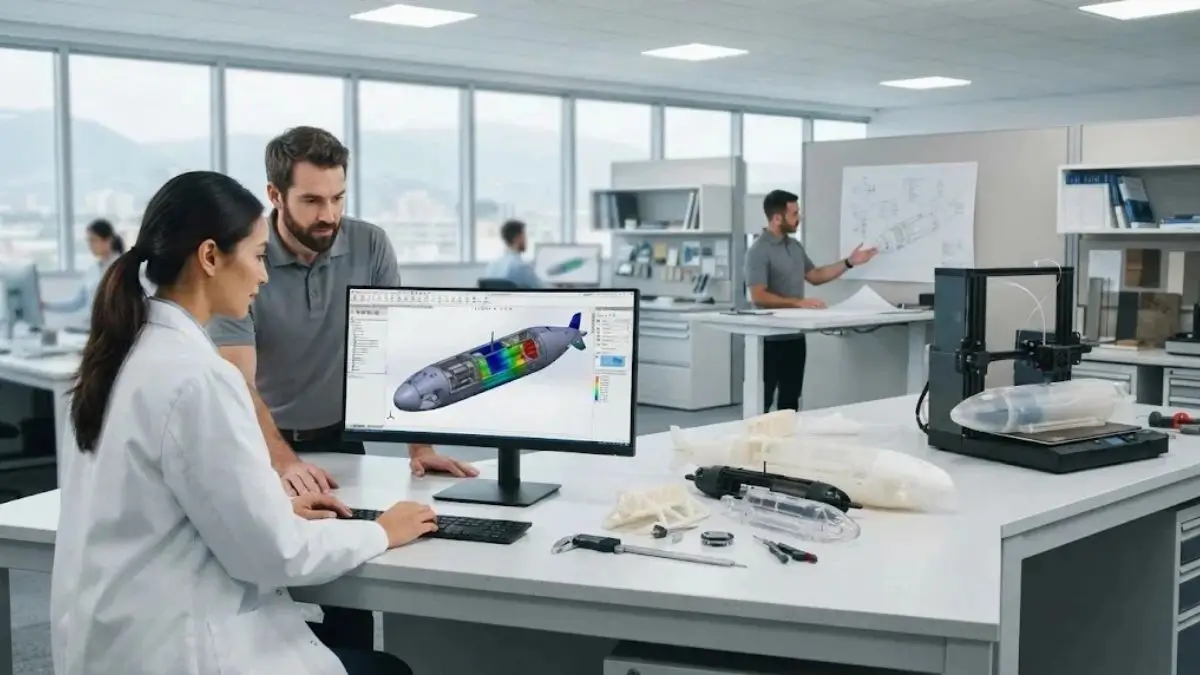
Engineering design is the structured, iterative decision-making process through which scientific knowledge, mathematical principles, and technical creativity are applied to plan, model, and optimize physical products, structures, machines, software architectures, and complex systems that fulfill specified human needs. Bridging the gap between theoretical science and practical technology, engineering design translates abstract physical laws into safe, reliable, manufacturable, and economically viable solutions.
Whether designing a microelectronic processor, a suspension bridge, a biomedical implant, or a renewable power grid, engineers operate under real-world constraints—including material strength, energy efficiency, cost, environmental impact, safety regulations, and human ergonomics.
Conceptual Definition and Core Purpose
While pure science asks why a natural phenomenon occurs, engineering design asks how to construct a functional artifact or system that performs reliably within defined boundaries. In professional engineering practice, a design problem rarely has a single “correct” answer; instead, engineers evaluate competing trade-offs to arrive at an optimal solution.
Every engineering design project balances two primary sets of parameters:
- Design Criteria (Objectives): The desired performance goals, such as speed, load capacity, battery life, user accessibility, or aesthetic form.
- Design Constraints (Boundaries): The non-negotiable limits imposed by physics, budget, manufacturing tolerances, legal standards, safety codes, and ecological sustainability.
Historical Evolution of Engineering Design
Engineering design evolved from intuitive craft traditions passed down through master-apprentice guilds into a rigorous, mathematically predictive discipline.
Ancient Master Builders and Empirical Craft
In antiquity, monumental projects—such as Egyptian pyramids, Mesopotamian irrigation canals, Roman aqueducts, and Gothic cathedrals—were designed through empirical rules of thumb, geometric ratios, and physical trial and error. Master builders relied on accumulated generational experience rather than formal calculus or material stress equations.
The Industrial Revolution and Standardization
During the eighteenth and nineteenth centuries, the rise of steam engines, iron metallurgy, and precision machine tools transformed design into an industrial profession. Engineers introduced standardized engineering drawings, interchangeable parts, and formal testing of material strength, enabling mass production in factories and safe construction of long-span steel bridges and railways.
Systems Engineering and the Digital Revolution
In the twentieth century, large-scale aerospace and defense projects—such as commercial jetliners and the Apollo space program—gave birth to systems engineering, which coordinates thousands of interdependent mechanical, electrical, and software subsystems. By the late twentieth century, Computer-Aided Design (CAD) and Finite Element Analysis (FEA) replaced paper drafting boards, allowing engineers to simulate structural stress, fluid dynamics, and thermal loads digitally before cutting a single piece of metal.
The Engineering Design Process
Modern engineering design follows an iterative, cyclical workflow rather than a strictly linear checklist. Engineers frequently revisit earlier stages as prototypes reveal unexpected behaviors or constraints:
- Problem Definition and Requirements Analysis: Identifying the user or societal need, defining measurable functional specifications, and establishing budget, regulatory, and environmental constraints.
- Background Research and Feasibility Study: Reviewing existing patents, scientific literature, material properties, and competing solutions to avoid reinventing established mechanisms.
- Conceptualization and Ideation: Generating multiple diverse design concepts through brainstorming, morphological charts, and functional decomposition before narrowing down options.
- Preliminary Design and Trade-Off Analysis: Evaluating candidate concepts using weighted decision matrices to balance cost, reliability, manufacturability, and performance.
- Detailed Design and Digital Modeling: Producing exact three-dimensional CAD assemblies, circuit schematics, material specifications, and dimensional tolerances.
- Simulation and Virtual Testing: Running computational simulations—such as Computational Fluid Dynamics (CFD) or stress analysis—to detect weak points and optimize geometry.
- Prototyping and Physical Testing: Building physical prototypes via CNC machining, 3D printing, or breadboarding, and subjecting them to rigorous laboratory and field stress tests.
- Iteration, Optimization, and Production Launch: Refining the design based on test data, finalizing Design for Manufacturing (DFM) plans, and scaling to full production.
Key Methodologies and Principles in Engineering Design
Contemporary engineering relies on specialized frameworks to ensure products remain safe, durable, and cost-effective throughout their lifecycle:
| Methodology / Principle | Core Focus | Practical Benefit |
| Design for Manufacturing (DFM) | Simplifying part geometry and reducing component counts | Lowers factory assembly costs and minimizes production defects |
| Design for Reliability & Safety | Incorporating safety factors, redundancy, and failure-mode analysis (FMEA) | Prevents catastrophic failure in aviation, medicine, and civil infrastructure |
| Human-Centered Design (Ergonomics) | Aligning controls, interfaces, and physical dimensions with human anatomy and cognition | Improves usability, comfort, and safety while reducing operator error |
| Sustainable / Eco-Design | Selecting recyclable materials, minimizing energy use, and planning end-of-life disassembly | Reduces carbon footprint and prevents electronic waste |
| Modular Architecture | Dividing complex systems into standardized, interchangeable sub-modules | Accelerates upgrades, simplifies maintenance, and extends product lifespan |
Major Disciplines of Engineering Design
Although the core design methodology is universal, its tools and constraints vary across engineering branches:
- Mechanical and Structural Design: Focuses on kinematics, thermodynamics, load-bearing structures, fluid systems, and precision machinery—ranging from automotive engines and wind turbines to earthquake-resistant skyscrapers.
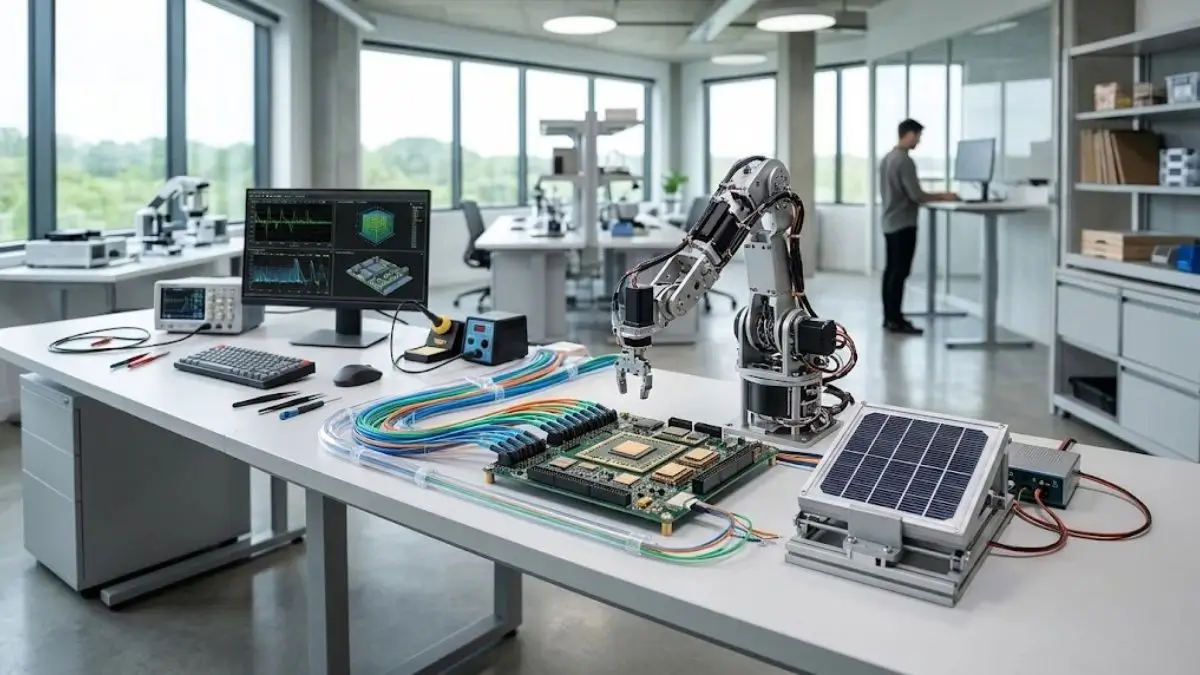
- Electrical and Electronic Design: Encompasses power distribution grids, printed circuit boards (PCBs), sensor networks, and nanometer-scale semiconductor chip layouts.
- Software and Systems Architecture: Applies engineering design principles to scalable cloud platforms, embedded firmware, cybersecurity protocols, and artificial intelligence pipelines.
- Biomedical and Chemical Design: Designs biocompatible medical devices, prosthetic limbs, bioreactor processes, and sustainable industrial chemical plants.
Modern Digital Tools Transforming Engineering Design
Technological advances have dramatically accelerated how engineers conceive, test, and refine complex systems:
- Generative Design and AI Optimization: Engineers input load requirements, material properties, and spatial boundaries into AI-driven generative design software, which automatically explores thousands of organic, lightweight structural geometries impossible to conceive manually.
- Digital Twins: A digital twin is a real-time virtual replica of a physical machine, factory, or jet engine fed continuously by Internet of Things (IoT) sensors, allowing engineers to monitor wear, test software updates, and predict maintenance needs safely.
- Additive Manufacturing (3D Printing): Rapid prototyping and industrial metal 3D printing allow engineers to test complex internal cooling channels and lightweight lattice structures within hours rather than waiting months for traditional tooling molds.
Ethics and Responsibility in Engineering Design
Because engineered systems directly affect human lives and the natural environment, professional engineering codes mandate that public health, safety, and welfare take top priority. Ethical engineering design requires transparent risk communication, rigorous quality assurance, inclusive accessibility for diverse users, and careful evaluation of long-term environmental and societal consequences before deployment.


3 thoughts on “Engineering Design”