
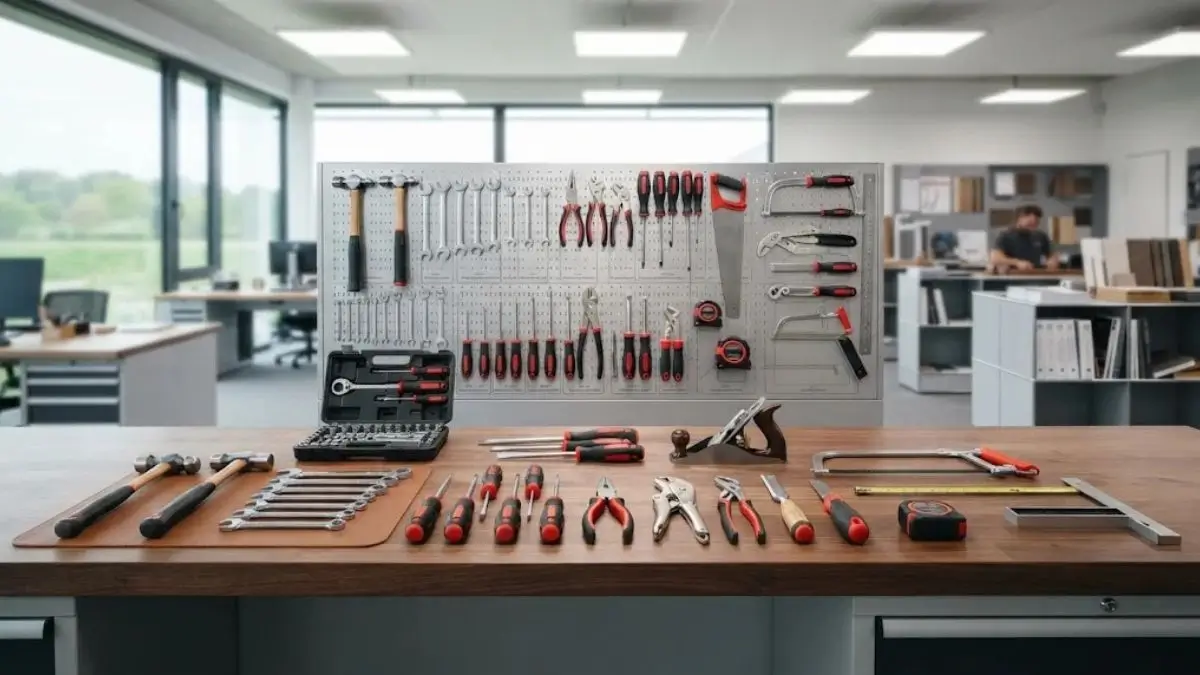
Hand tools are non-motorized, manually operated implements powered directly by human muscular force rather than electricity, internal combustion engines, or compressed air. Representing the oldest and most fundamental branch of human technology, hand tools extend the mechanical advantage, precision, grip, and striking power of the human hand to shape materials, assemble structures, repair machinery, and cultivate land.
From prehistoric chipped flint blades to modern chrome-vanadium wrenches and precision micro-screwdrivers, hand tools have remained indispensable across carpentry, metalworking, construction, automotive repair, electronics, and household maintenance—even in an era dominated by power tools and industrial automation.
Conceptual Definition and Mechanical Principles
Unlike power tools—which rely on external energy sources such as batteries, electrical outlets, or pneumatic compressors—a hand tool converts direct human physical effort into controlled mechanical work. Every hand tool operates on one or more of the six classical simple machines first systematized by ancient Greek engineers:
- Lever: Amplifies applied force across a fulcrum, as seen in crowbars, pliers, wrenches, and claw hammers.
- Wedge: Concentrates force onto a narrow, sharp edge to split, slice, or pierce material, forming the basis of axes, chisels, knives, and handsaws.
- Inclined Plane and Screw: Converts rotational motion into linear clamping or fastening force, utilized in screwdrivers, C-clamps, vises, and hand augers.
- Wheel and Axle: Increases rotational torque when turning fasteners or boring holes, seen in T-handle hex keys, brace-and-bit drills, and pipe cutters.
Historical Evolution of Hand Tools
The development of hand tools marks the foundational chapters of human civilization, closely mirroring advances in materials science and metallurgy.
Paleolithic Stone Implements
The earliest known hand tools date back approximately 2.6 million years to the Oldowan stone tool tradition in East Africa, where early hominins struck river cobbles to create sharp stone flakes for cutting meat and woodworking. By 1.7 million years ago, Homo erectus crafted symmetrical Acheulean hand axes, followed during the Upper Paleolithic by specialized flint scrapers, burins, bone needles, and hafted stone-tipped spears.
Neolithic Polish and Agricultural Tools
During the Neolithic Revolution (beginning around 10,000 BCE), settled farming communities developed ground and polished stone axes capable of clearing dense forests, alongside flint-bladed sickles for harvesting grain, stone adzes for timber shaping, and digging sticks and wooden hoes for soil cultivation.
The Bronze and Iron Ages
The discovery of metallurgy revolutionized hand tool durability and geometry. Copper and bronze (c. 4000 BCE) allowed craftsmen to cast metal saws, chisels, and hammers that held sharper edges than stone and could be resharpened rather than discarded. Around 1200 BCE, the Iron Age made tough, forged iron tools affordable for everyday artisans, introducing early versions of tongs, anvils, files, and hinged shears.
Roman Standardization and Medieval Craft Guilds
Roman engineers standardized specialized hand tools for masonry, carpentry, and plumbing—including frame saws, claw hammers, folding bronze rulers, plumb bobs, and early ironwood planes. During the Middle Ages, craft guilds refined specialized hand tools for blacksmithing, coopering, stonecutting, and clockmaking, establishing tool patterns still recognizable today.
Industrial Steel Alloys and Modern Ergonomics
During the nineteenth and twentieth centuries, the Bessemer steelmaking process and the development of alloy steels—such as high-carbon steel and chrome-vanadium steel—dramatically increased tool strength, corrosion resistance, and edge retention. Modern manufacturing added drop-forged construction, precision-machined jaws, ratcheting mechanisms, and cushioned, slip-resistant polymer grips designed through human-centered ergonomics.
Classification of Hand Tools by Function
Hand tools are systematically categorized according to the primary mechanical operation they perform on a workpiece:
| Functional Category | Primary Purpose | Representative Hand Tools |
| Striking Tools | Deliver concentrated impact force to drive fasteners or shape materials | Claw hammer, ball-peen hammer, sledgehammer, rubber mallet |
| Fastening and Turning Tools | Apply rotational torque to tighten or loosen screws, bolts, and nuts | Flathead and Phillips screwdrivers, combination wrenches, socket ratchets, hex keys |
| Gripping and Holding Tools | Clamp, twist, bend, or immobilize objects during work | Slip-joint pliers, needle-nose pliers, locking pliers, bench vises, C-clamps |
| Cutting and Shaping Tools | Sever, pare, or remove material through sharp edges or teeth | Handsaws, utility knives, wood chisels, tin snips, hand planes, files |
| Measuring and Layout Tools | Determine length, angles, levelness, and reference lines accurately | Tape measure, steel ruler, combination square, spirit level, calipers |
| Prying and Demolition Tools | Separate joined components or lift heavy objects via leverage | Crowbar, flat pry bar, nail puller, cold chisel |
Essential Hand Tools Across Key Trades
While general household toolkits cover basic repairs, specialized trades rely on purpose-built hand tools engineered for specific materials and tolerances:
Woodworking and Carpentry
Carpenters and cabinetmakers rely on tools designed to cut and smooth wood fibers cleanly—including rip and crosscut handsaws, bevel-edge chisels, block and jack planes, marking gauges, mallets, and speed squares.
Metalworking and Automotive Repair
Mechanics and machinists work with high-strength steel fasteners and hard metals requiring high torque and precision—utilizing box-end and open-end wrenches, ratcheting socket sets, torque wrenches, ball-peen hammers, center punches, hacksaws, and metal files.
Electrical and Electronics Work
Electricians and technicians use specialized hand tools engineered for fine wire manipulation and electrical safety—including insulated screwdrivers and pliers (rated to protect against electrical shock), wire strippers, crimping tools, diagonal cutters, and precision tweezers.
Masonry and Construction
Masons, bricklayers, and builders use durable tools designed for stone, brick, and mortar—including brick trowels, pointing trowels, mason’s hammers, cold chisels, chalk lines, and long spirit levels.
Materials, Ergonomics, and Tool Safety
Modern hand tools balance hardness, toughness, and user comfort through careful material selection and engineering design:
- Metallurgy and Coatings: Striking faces and cutting edges are heat-treated and tempered to resist chipping while maintaining hardness. Wrenches and sockets are commonly forged from chrome-vanadium or chrome-molybdenum steel and plated with nickel-chrome finishes to prevent rust.
- Ergonomic Handle Design: Dual-material handles combining rigid polypropylene cores with textured thermoplastic elastomer (TPE) grips absorb shock, increase friction in oily conditions, and reduce repetitive strain injuries during prolonged use.
- Safety and Maintenance: Proper hand tool safety requires selecting the correct tool size for each fastener to prevent slipping, cutting away from the body, wearing safety glasses when striking metal or chiseling, keeping cutting edges sharp, and storing tools dry and clean to prevent corrosion.
Hand Tools vs. Power Tools
Although power tools perform heavy cutting, drilling, and fastening far faster than manual implements, hand tools remain irreplaceable in modern workshops and field service:
- Precision and Tactile Feedback: Manual screwdrivers, chisels, and torque wrenches allow workers to feel subtle material resistance, preventing stripped threads or over-tightened delicate components.
- Portability and Independence: Hand tools require no batteries, charging stations, electrical outlets, or fuel, functioning reliably in remote locations, wet environments, and power outages.
- Durability and Cost: Well-forged hand tools contain few or no moving parts, cost significantly less than motorized equivalents, and can last for generations with minimal maintenance.



One thought on “Hand Tools”