
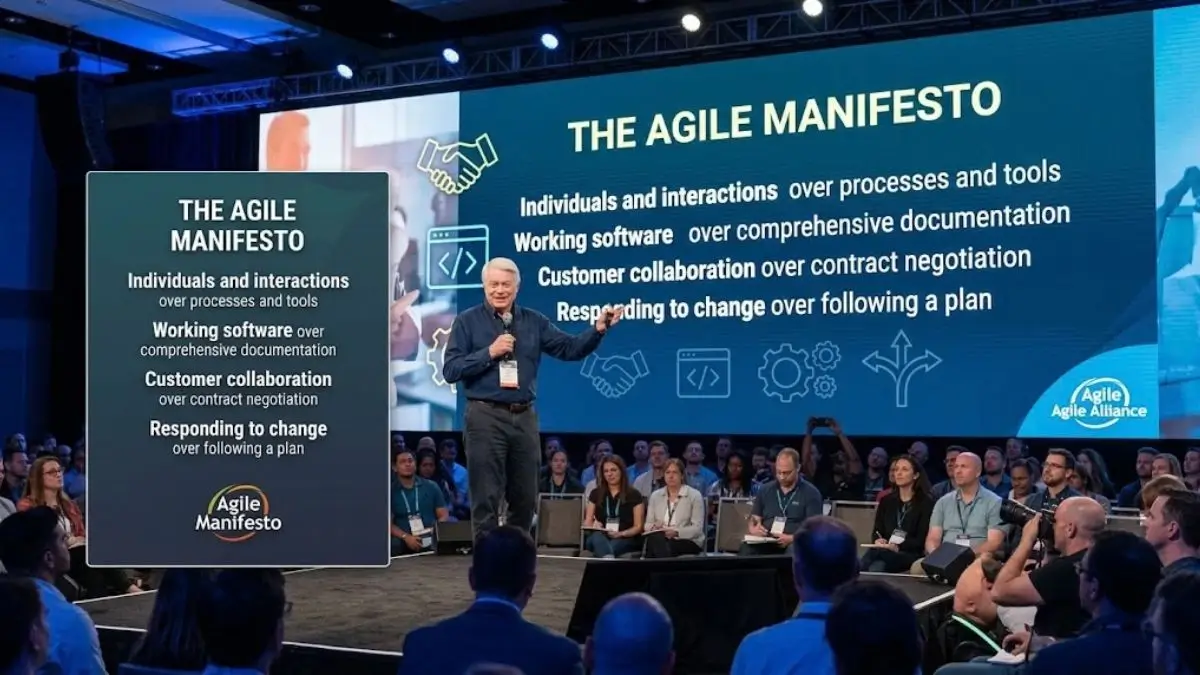
In the fast-evolving world of technology, speed, flexibility, and collaboration are the ultimate markers of success. However, before the early 2000s, the software industry was heavily bogged down by the “Waterfall” model—a rigid, slow, and overly bureaucratic methodology where changes were difficult to make once a project started.
Everything changed in February 2001, when a group of 17 software pioneers met at a ski resort in Utah, USA. Frustrated by industry delays, they co-authored the Manifesto for Agile Software Development, creating a flexible mindset that today powers global giants like Google, Apple, and Spotify.
The 4 Core Values of Agile
The entire philosophy of the Agile Manifesto is built upon four foundational pillars that prioritize human interaction and adaptability over rigid planning:
- Individuals and interactions over processes and tools.
- Working software over comprehensive documentation.
- Customer collaboration over contract negotiation.
- Responding to change over following a plan.
While the manifesto acknowledges that the items on the right have value, it explicitly states that the industry must value the items on the left more.
The Principles of Agility
Supporting these four values are 12 core principles. These principles emphasize delivering functional software frequently (in short cycles called “sprints”), maintaining close daily collaboration between business stakeholders and developers, and welcoming changing requirements—even late in the development cycle.
The AI Era (2026 Shift)
Twenty-five years after its inception, the Agile Manifesto is experiencing a massive modern evolution due to the rise of fully automated AI agents and code-generation models. Modern software thought leaders (including original co-author Robert C. “Uncle Bob” Martin) are actively redefining what these values mean today.
With AI tools writing code at unprecedented speeds, the focus of “Agile” has shifted from how teams write code to how they set up automated constraints, mutation testing, and architectural guardrails to ensure AI-driven development remains safe and efficient.
Conclusion
The Agile Manifesto was more than just a technical guide; it was a cultural shift. By shifting the focus from rigid documentation to human empathy, teamwork, and quick adaptation, it didn’t just fix software development—it created the framework for the modern, fast-paced digital world we live in today.



One thought on “The Agile Manifesto: The Revolutionary Blueprint That Changed Modern Tech Industry”