
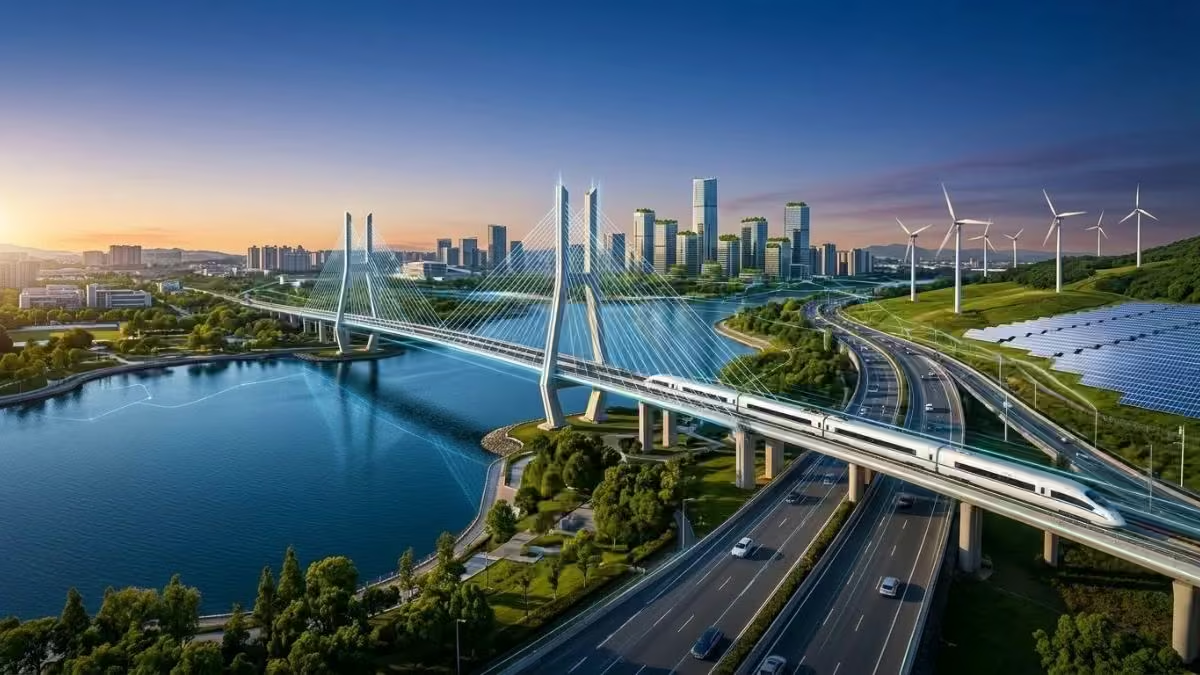
Infrastructure refers to the fundamental physical and organizational structures, facilities, and systems required for a society, city, or economy to function smoothly. From the roads, bridges, and power grids we rely on every day to high-speed fiber-optic networks, water treatment plants, and public hospitals, infrastructure forms the invisible backbone of modern civilization.
Without reliable infrastructure, businesses cannot transport goods, homes lose access to clean water and electricity, and communities struggle to connect or grow. Understanding what infrastructure includes, how it has evolved, and why ongoing investment matters is essential for grasping how modern economies thrive and adapt to future challenges.
This comprehensive guide explores the definition, history, major categories, economic impact, and future trends shaping global infrastructure.
Defining What Makes Infrastructure
At its core, infrastructure consists of large-scale public and private systems that deliver essential services to households, industries, and governments. Unlike individual consumer products, infrastructure assets are typically long-lasting, capital-intensive, and interconnected—meaning the performance of one system directly affects others.
Economists and urban planners generally divide infrastructure into two broad pillars:
- Hard (Physical) Infrastructure: The tangible networks and engineered facilities required for transport, energy, water, and communications—such as highways, railways, electrical grids, dams, pipelines, and cell towers.
- Soft (Social and Institutional) Infrastructure: The human-centered systems and institutions that maintain economic, health, cultural, and social standards—such as schools, universities, hospitals, emergency services, courts, and financial networks.
Together, hard and soft infrastructure create the foundation that enables daily life and long-term economic productivity.
The History and Evolution of Infrastructure
Human civilizations have always risen and thrived alongside their ability to build shared public works.
1. Ancient Public Works
Early empires recognized that trade, agriculture, and defense depended on coordinated engineering:
- Water and Irrigation: Ancient Mesopotamian and Indus Valley civilizations constructed sophisticated canal networks, reservoirs, and urban drainage systems thousands of years ago.
- Roads and Aqueducts: The Roman Empire built over 250,000 miles of paved roads to connect distant provinces, alongside stone aqueducts that carried fresh water into cities across Europe and the Mediterranean.
- Fortifications and Canals: Ancient China engineered monumental projects such as the Grand Canal—the world’s longest artificial waterway—to transport grain and unite regional economies.
2. The Industrial Revolution and Urbanization
During the 18th and 19th centuries, rapid industrialization transformed infrastructure from regional projects into nationwide networks. Steam locomotives drove the expansion of continental railways, iron and steel enabled longer suspension bridges, and growing cities developed underground sewer systems, paved streets, and gas lighting to improve public health and mobility.
3. The 20th Century: Electricity, Highways, and Aviation
The 20th century brought unprecedented expansion in scale and speed. National electrical grids brought power to rural and urban communities alike; expansive highway systems transformed personal and freight transport; and commercial airports and container seaports connected global supply chains.
4. The Digital Era and Smart Infrastructure
In the late 20th and 21st centuries, information technology became an indispensable utility. Undersea fiber-optic cables, data centers, cellular networks, and satellite constellations now carry the world’s digital traffic, while sensors and artificial intelligence are increasingly embedded into physical grids to monitor performance in real time.
Major Categories of Modern Infrastructure
Modern infrastructure spans several critical sectors, each supporting a distinct pillar of daily life:
1. Transportation Infrastructure
Transportation networks move people, raw materials, and finished goods locally and globally.
- Land: Highways, expressways, bridges, tunnels, railways, subways, and bus rapid transit (BRT) corridors.
- Water: Deep-water seaports, shipping canals, inland waterways, and ferry terminals.
- Air: International and regional airports, runways, and air traffic control systems.
2. Energy and Power Infrastructure
Energy infrastructure generates, transmits, and distributes power to homes, factories, and businesses.
- Generation: Hydroelectric dams, thermal power plants, solar farms, wind turbines, and nuclear facilities.
- Transmission & Distribution: High-voltage power lines, substations, local electrical grids, natural gas pipelines, and fuel storage terminals.
3. Water and Waste Management Infrastructure
Clean water and sanitation are vital for public health and environmental protection.
- Water Supply: Dams, reservoirs, aquifers, desalination plants, water purification facilities, and underground distribution pipes.
- Sanitation & Waste: Wastewater treatment plants, storm drains, flood-control levees, recycling centers, and solid waste landfills.
4. Digital and Telecommunications Infrastructure
Often called the nervous system of the modern economy, digital infrastructure enables instant communication, cloud computing, and e-commerce.
- Core Assets: Fiber-optic broadband cables, 5G wireless towers, communication satellites, internet exchange points, and hyperscale data centers.
5. Social Infrastructure
Social infrastructure supports human capital, well-being, and civic stability.
- Core Assets: Public schools, universities, research laboratories, hospitals, clinics, public parks, libraries, and municipal emergency response centers.
Why Infrastructure Matters to the Economy and Society
Investing in well-planned infrastructure generates wide-ranging ripple effects across every level of society:
- Economic Growth and Job Creation: Construction, engineering, and maintenance create direct employment, while faster transport and cheaper energy lower business costs and attract private investment.
- Improved Public Health and Safety: Reliable clean water, modern sanitation, and accessible hospitals dramatically reduce preventable diseases and increase life expectancy.
- Supply Chain Resilience: Efficient ports, highways, and rail links prevent bottlenecks, keep consumer prices stable, and enable farmers and manufacturers to reach broader markets.
- Social Mobility and Equity: Public transit, quality schools, and widespread broadband access connect underserved neighborhoods to jobs, education, and healthcare.
Key Challenges Facing Modern Infrastructure
Despite its importance, infrastructure systems worldwide face growing pressures:
- Aging Assets and Maintenance Backlogs: Many bridges, water pipes, and power grids built decades ago are operating beyond their intended lifespans and require costly upgrades.
- Funding Gaps: Large-scale projects require massive upfront capital, often straining public budgets and requiring innovative public-private partnerships (PPPs).
- Climate Change and Extreme Weather: Floods, heatwaves, storms, and rising sea levels place unprecedented stress on roads, coastal ports, and electrical grids, demanding climate-resilient engineering.
- Rapid Urbanization: Growing cities face intense congestion, housing shortages, and rising demand for water, power, and public transit.
The Future of Infrastructure: Smart, Green, and Resilient
To meet 21st-century demands, engineers and policymakers are rethinking how infrastructure is designed and operated:
- Smart Infrastructure: Internet of Things (IoT) sensors, digital twins, and AI analytics allow operators to detect bridge wear, water leaks, or power grid surges before catastrophic failures occur.
- Clean Energy Grids: Modern grids are evolving to integrate distributed renewable energy, utility-scale battery storage, and widespread electric vehicle (EV) charging networks.
- Sustainable and Green Design: Permeable pavements, urban green spaces, low-carbon concrete, and circular water recycling help cities reduce emissions and manage stormwater naturally.
Frequently Asked Questions (FAQs)
What is the simplest definition of infrastructure?
Infrastructure is the foundational set of physical systems and public facilities—such as roads, power grids, water networks, and telecommunications—that a society needs to operate and grow.
What is the difference between hard and soft infrastructure?
Hard infrastructure includes physical structures like bridges, railways, pipelines, and cell towers. Soft infrastructure includes institutions and services that support society, such as healthcare systems, schools, legal frameworks, and banking networks.
Why is digital connectivity now considered critical infrastructure?
Modern banking, healthcare, education, remote work, and emergency services depend on uninterrupted internet access. As a result, broadband networks and data centers are now treated as essential utilities alongside electricity and water.
How is large-scale infrastructure funded?
Infrastructure is typically funded through government tax revenues, municipal bonds, international development loans, user fees (such as tolls and utility bills), or Public-Private Partnerships (PPPs).
Conclusion
Infrastructure is the silent engine behind every thriving community and modern economy. From ancient stone aqueducts to smart electrical grids and global fiber-optic networks, the systems we build today determine how safely, sustainably, and prosperously future generations will live. Prioritizing resilient, forward-looking infrastructure ensures that societies remain connected, productive, and prepared for the challenges ahead.



5 thoughts on “Infrastructure”