
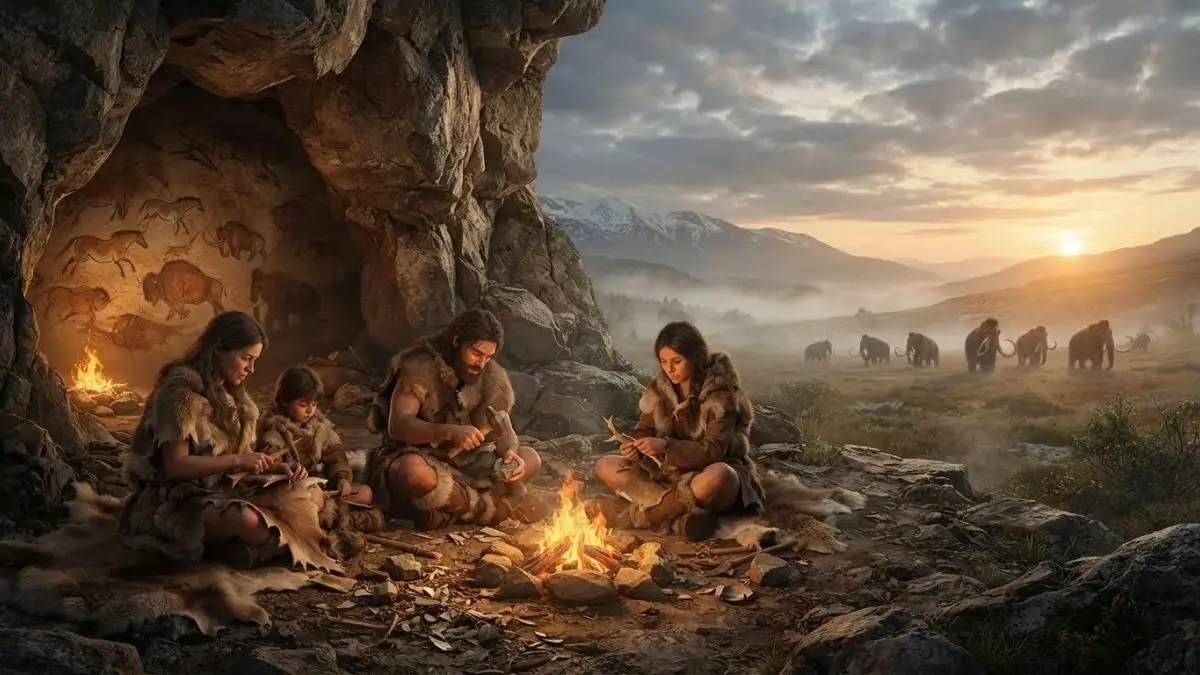
The Paleolithic period—also known as the Old Stone Age—is the earliest and longest phase of human prehistory, spanning from roughly 3.3 million to 2.6 million years ago until about 10,000 BCE (or ~11,650 years ago). Defined by the use of chipped stone tools, mobile hunter-gatherer lifeways, and overlapping Pleistocene glacial cycles, the Paleolithic laid the biological, technological, and cultural foundations of modern humanity.
What the Paleolithic Is and When It Occurred
Coined in 1865 from Greek roots meaning “old” (paleo) and “stone” (lithos), the Paleolithic covers more than 99% of human technological history. Archaeologists typically divide it into three broad stages—the Lower, Middle, and Upper Paleolithic—ending around the close of the last Ice Age when warming climates and shifting economies gave rise to the Mesolithic and Neolithic periods.
- Lower Paleolithic (c. 3.3–2.6 million to 300,000–250,000 years ago): Marked by the earliest stone tool traditions (such as Oldowan and Acheulean industries), early Homo species like Homo habilis and Homo erectus, migration out of Africa, and the growing control of fire.
- Middle Paleolithic (c. 300,000–250,000 to 50,000–30,000 years ago): Characterized by prepared-core stone knapping (such as the Levallois technique and Mousterian tools), hafted spears, Neanderthals and early Homo sapiens, early pigment use, and intentional burials.
- Upper Paleolithic (c. 50,000–40,000 to 10,000 years ago): Associated with behavioral modernity in Homo sapiens, finer blades and bone/antler/ivory tools (needles, harpoons, spear-throwers, bows), cave art, portable sculptures, musical instruments, and expansion into new regions.
Hominins, Migration, and Ice Age Environments
Rather than belonging to a single species or static climate, the Paleolithic saw the emergence and evolution of multiple hominins across dramatic environmental swings. During the Pleistocene epoch, advancing and retreating ice sheets reshaped coastlines, grasslands, forests, and animal communities.
- African origins and dispersal: Early toolmakers and Homo species originated in Africa before Homo erectus dispersed into Eurasia around 1.8 million years ago, reaching sites across Asia and Europe.
- Coexistence and evolution: Different hominin groups—including Homo erectus, Homo heidelbergensis, Neanderthals, Denisovans, and eventually Homo sapiens—adapted to varied habitats and interacted or interbred across time.
- Climate adaptation: Cold glacial phases pushed groups toward shelters, animal hides, and hearths, while warmer interglacial periods opened new corridors for movement and foraging.
Stone Tools, Fire, and Survival Technology
Stone tools give the era its name, though Paleolithic people also relied on organic materials like wood, bone, antler, ivory, hide, and plant fibers that survive less often in the archaeological record.
- Knapping and core tools: Early hominins struck stones together to create sharp flakes for cutting meat, scraping hides, and processing plants, later shaping symmetrical bifacial hand axes in the Acheulean tradition.
- Prepared cores and composite weapons: Middle and Upper Paleolithic toolmakers refined flake and blade production, attached stone or bone points to shafts, and invented specialized hunting and crafting gear such as spear-throwers, bows and arrows, fishhooks, and eyed bone needles.
- Control of fire: Mastering fire provided warmth in cold climates, deterred predators, extended waking hours, and transformed food preparation by making tough or toxic foods safer and easier to digest.
Hunter-Gatherer Lifeways and Diet
For millions of years, Paleolithic groups lived primarily by foraging—hunting, fishing, scavenging, and gathering wild foods—rather than farming or herding. Bands were typically small and mobile, moving seasonally to track game, water, and ripe plants.
- Varied omnivorous diets: Depending on season and geography, diets included wild fruits, tubers, roots, greens, nuts, seeds, honey, eggs, shellfish, fish, birds, and land animals ranging from small game to large Pleistocene mammals.
- No single “Paleo” menu: Archaeological and isotopic evidence shows there was no uniform global diet; coastal groups ate more marine resources, cold-region groups relied more heavily on animal fats and protein, and many foraging populations consumed substantial plant foods.
- Social organization: Small bands depended on cooperation, food sharing, knowledge of local landscapes, and trade or contact between neighboring groups.
Art, Symbolism, and Early Ritual
Especially in the Middle and Upper Paleolithic, material culture reflects growing symbolic thought, shared traditions, and social expression.
- Cave and rock art: Wall paintings, engravings, and reliefs—such as famous Upper Paleolithic sites in Europe and rock shelters elsewhere—depicted animals, geometric marks, and human figures using mineral pigments like ochre and charcoal.
- Portable art and music: Carvings in bone, ivory, and stone—including animal figures and Venus figurines—alongside personal ornaments and bone or ivory flutes point to rich cultural and aesthetic life.
- Burials and belief: Intentional graves, sometimes accompanied by grave goods or pigments, suggest grief, memory, and early spiritual or ritual practices.
Why the Paleolithic Matters Today
Studying the Paleolithic helps explain how human biology and culture took shape long before written history or agriculture. Changes in brain size, diet, tool use, and social learning allowed early humans to thrive in diverse environments, setting the stage for the agricultural revolution and every technological era that followed.



2 thoughts on “Paleolithic”