
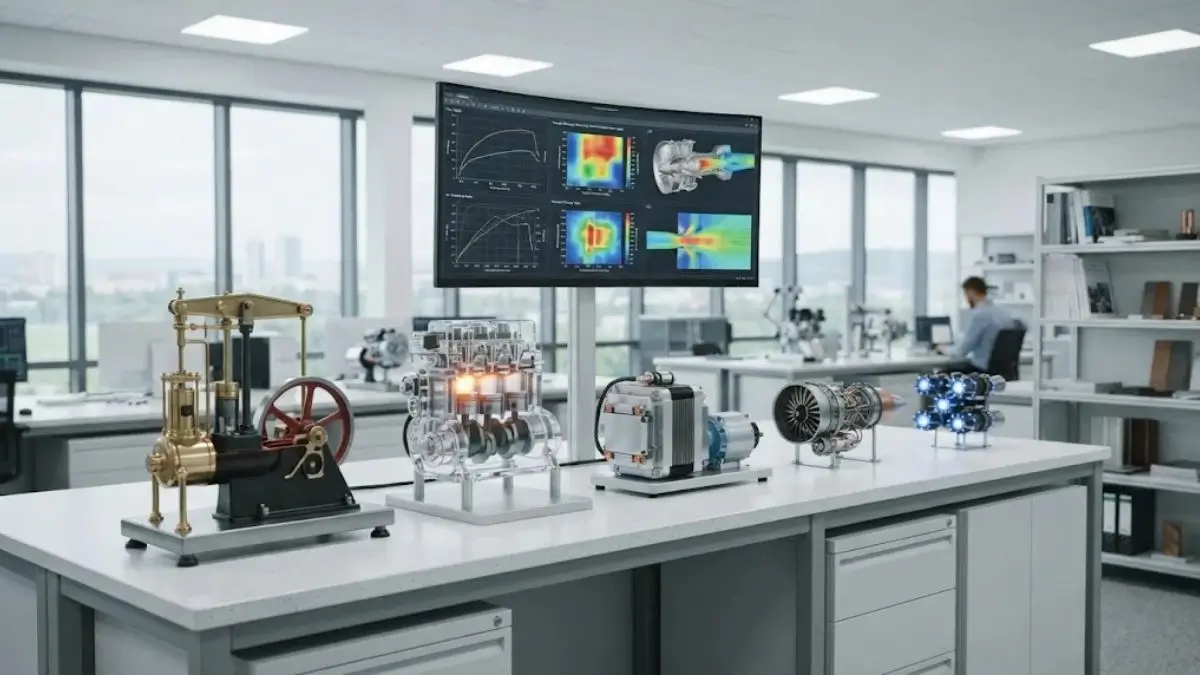
Engines are the mechanical powerhouses that convert various forms of energy into physical motion, driving modern civilization forward. From the smallest handheld tools to massive cargo ships and space rockets, engines enable transportation, power industries, and shape daily life across the globe.
Introduction to Engines
At its most basic level, an engine is a machine designed to transform energy into useful mechanical work. The energy input can come from many different sources, such as chemical energy stored in fossil fuels, electrical energy from batteries, or thermal energy from steam. Without engines, human society would still rely entirely on muscle power, wind, and flowing water to move goods and operate machinery.
The word “engine” comes from the Old French word engin, which means skill, cleverness, or invention. Over the centuries, the meaning narrowed to describe complex mechanical devices that produce power. Today, engineers often distinguish between an “engine” and a “motor.” Traditionally, an engine burns fuel to create heat and motion, while a motor uses electricity or compressed fluid to create movement. However, in everyday conversation, people use both terms interchangeably to describe the power unit inside a vehicle or machine.
A Brief History of Engine Development
The story of the engine spans thousands of years, beginning with simple ancient experiments and leading to modern aerospace marvels.
- The Aeolipile (1st Century AD): Greek mathematician Hero of Alexandria invented the first recorded steam-powered device. It was a hollow metal sphere that spun rapidly when steam escaped through bent nozzles, serving mostly as a scientific curiosity rather than a working machine.
- The Atmospheric Steam Engine (1712): English inventor Thomas Newcomen built the first practical fuel-burning engine to pump water out of flooded coal mines. It used condensing steam to create a vacuum that pulled a large wooden beam downward.
- James Watt’s Steam Engine (1769): Scottish engineer James Watt dramatically improved Newcomen’s design by adding a separate condenser. This breakthrough saved massive amounts of coal and sparked the Industrial Revolution, powering factories, trains, and steamships worldwide.
- The Four-Stroke Internal Combustion Engine (1876): German engineer Nikolaus Otto developed the first successful four-stroke gas engine. His “Otto cycle” became the blueprint for nearly all modern gasoline car engines.
- The Diesel Engine (1893): Rudolf Diesel patented an engine that ignited fuel using high compression instead of a spark plug. Diesel engines proved far more fuel-efficient and powerful for heavy trucks, trains, and ships.
- The Jet Engine (1930s): Frank Whittle in England and Hans von Ohain in Germany independently developed the first turbojet engines. Their inventions allowed aircraft to fly much higher and faster than propeller planes ever could.
How Engines Convert Energy into Motion
Every engine follows the fundamental laws of thermodynamics, which state that energy cannot be created or destroyed, only changed from one form to another. Most traditional engines rely on heat to do work.
When fuel burns inside an engine, chemical bonds break apart and release intense heat. This heat causes gases inside the engine to expand rapidly, creating high pressure. The engine channels this expanding gas against a movable part, such as a piston or a turbine blade. As the gas pushes that part, thermal energy transforms into mechanical motion. Finally, gears, shafts, and axles transfer that motion to spin wheels, turn propellers, or generate electricity.
Major Classifications of Engines
Engineers group engines into distinct categories based on where the fuel burns and what kind of energy they consume.
1. Internal Combustion Engines (ICE)
Internal combustion engines burn fuel directly inside a closed chamber within the engine itself. Because the combustion happens internally, these engines are compact, lightweight, and quick to start. They power the vast majority of passenger cars, motorcycles, lawnmowers, and small aircraft.
2. External Combustion Engines (ECE)
External combustion engines burn fuel outside the main working chamber. The heat from the fire boils water in a separate boiler to create high-pressure steam, which then enters the engine to push pistons or spin turbines. While rare in cars today, steam turbines still generate a huge percentage of the world’s electricity inside coal, natural gas, and nuclear power plants.
3. Reaction Engines (Jets and Rockets)
Reaction engines operate on Isaac Newton’s third law of motion, which states that for every action, there is an equal and opposite reaction. Instead of turning wheels, these engines shoot a high-speed stream of hot exhaust gas backward. The force of that escaping gas pushes the aircraft or rocket forward at tremendous speeds.
4. Electric Motors
Electric motors do not burn fuel at all. Instead, they use electrical energy from batteries, solar panels, or power grids to create opposing magnetic fields. These magnetic forces spin a central rotor smoothly and quietly. Electric motors are over 85% efficient at converting energy into motion, compared to roughly 20% to 35% for traditional gasoline engines.
Core Components of a Car Engine
A typical gasoline engine contains hundreds of moving parts, but several core components do the heavy lifting to keep a vehicle moving.
- Engine Block: This heavy metal foundation, usually made of cast iron or aluminum, houses the cylinders and internal passages for coolant and oil.
- Cylinders: These are smooth, hollow tubes bored into the engine block where fuel and air mix and burn. Most cars have four, six, or eight cylinders arranged in a straight line or a “V” shape.
- Pistons: These cylindrical metal plugs fit tightly inside each cylinder. When fuel explodes above them, the force drives the pistons downward at high speed.
- Connecting Rods: These sturdy metal arms link each piston to the crankshaft below, transferring the downward force of the explosion.
- Crankshaft: Located at the bottom of the engine, the crankshaft converts the straight up-and-down movement of the pistons into a smooth rotational motion that eventually turns the car’s wheels.
- Camshaft and Valves: Intake valves open to let fresh air and fuel enter the cylinder, while exhaust valves open to let burned gases escape. The camshaft controls the exact timing of these valves.
- Spark Plugs: Mounted at the top of each cylinder in gasoline engines, spark plugs deliver a high-voltage electric spark at the precise moment needed to ignite the compressed fuel.
The Four-Stroke Cycle Explained
Most modern cars use a four-stroke internal combustion cycle, often summarized as “suck, squeeze, bang, blow.” Each stroke represents one full movement of the piston either up or down inside the cylinder.
- Intake Stroke: The piston moves downward, creating a vacuum inside the cylinder. The intake valve opens, drawing in a fine mist of fuel and fresh air.
- Compression Stroke: Both valves close tightly, and the piston moves back upward. It squeezes the fuel-air mixture into a tiny space at the top of the cylinder, heating it up and making it highly volatile.
- Power Stroke: Just as the piston reaches the top, the spark plug fires. The mixture ignites in a controlled explosion, forcing the piston downward with tremendous energy. This is the only stroke that actually produces power to move the vehicle.
- Exhaust Stroke: The exhaust valve opens as the piston rises once again. The upward movement pushes the leftover burned gases out of the cylinder and into the exhaust pipe, preparing the chamber for the next cycle.
In a typical car driving at highway speeds, this entire four-step cycle happens inside every cylinder roughly 30 to 50 times per second.
Comparing Modern Propulsion Technologies
As technology evolves, drivers and industries have more engine choices than ever before. Each technology offers distinct strengths and trade-offs.
| Engine Type | Primary Energy Source | Energy Efficiency | Key Advantages | Main Limitations |
| Gasoline Engine | Liquid petroleum | 20% – 30% | Low upfront cost, fast refueling, lightweight | High carbon emissions, wasted heat energy |
| Diesel Engine | Diesel fuel | 35% – 45% | High pulling torque, strong fuel economy | Higher nitrogen oxide emissions, louder noise |
| Hybrid Powertrain | Gasoline + Battery | 35% – 45% | Excellent city mileage, no range anxiety | Mechanical complexity, heavier vehicle weight |
| Battery Electric | Grid electricity | 85% – 90% | Zero tailpipe emissions, instant acceleration | Longer charging times, expensive battery packs |
| Hydrogen Fuel Cell | Compressed hydrogen | 50% – 60% | Emits only water vapor, refuels in minutes | Very few refueling stations, costly fuel production |
Cooling, Lubrication, and Exhaust Systems
An engine cannot survive on fuel and air alone. Without supporting systems, friction and extreme heat would destroy the metal components within minutes.
The Lubrication System
Inside an operating engine, metal parts rub against each other thousands of times per minute. An oil pump circulates motor oil from a pan at the bottom of the engine through tiny channels to coat the pistons, bearings, and camshaft. This thin film of oil reduces friction, prevents metal wear, traps microscopic dirt particles, and helps carry heat away from internal surfaces.
The Cooling System
Burning fuel generates temperatures exceeding 2,000°C (3,600°F) inside the cylinders. To prevent the metal engine block from melting or warping, a water pump pushes liquid coolant through hollow jackets surrounding the cylinders. The hot coolant then flows to the front of the car into a radiator, where rushing air cools the liquid before it cycles back into the engine.
The Exhaust and Emissions System
Burning fossil fuels creates harmful gases like carbon monoxide, hydrocarbons, and nitrogen oxides. Modern engines route exhaust gases through a catalytic converter, which uses precious metals like platinum and rhodium to trigger chemical reactions that turn toxic pollutants into harmless water vapor, nitrogen, and carbon dioxide. A muffler then reduces the loud acoustic shockwaves of the engine before the gases exit the tailpipe.
The Future of Engine Technology
The global engineering landscape is undergoing its biggest transformation since the invention of the automobile. Governments, automakers, and aerospace companies are racing to cut greenhouse gas emissions and improve energy efficiency.
- Electrification: Battery-electric motors are rapidly replacing internal combustion engines in passenger cars, city buses, and delivery vans. Advances in solid-state batteries promise longer driving ranges and faster charging times over the next decade.
- Hydrogen Combustion and Fuel Cells: For heavy-duty machines like cargo ships, mining trucks, and long-haul airplanes where batteries are too heavy, hydrogen offers a clean alternative. Engineers are developing both hydrogen fuel cells that generate electricity and modified combustion engines that burn hydrogen directly without producing carbon dioxide.
- Synthetic E-Fuels: Researchers are creating carbon-neutral liquid fuels by combining captured carbon dioxide from the air with green hydrogen. These synthetic fuels could allow existing cars, classic vehicles, and commercial airliners to keep operating with net-zero emissions.
- Turbocharging and Downsizing: Modern gasoline engines are becoming much smaller while producing more power than older V8 engines. By using exhaust-driven turbochargers to force extra air into small cylinders, engineers achieve strong performance while burning far less fuel.
Conclusion
Engines remain one of humanity’s greatest technological achievements. By mastering the conversion of heat, chemical reactions, and electricity into controlled mechanical motion, engineers have connected continents, built modern cities, and launched explorers into space. Whether powered by fossil fuels, hydrogen, or clean electricity, engines will continue to evolve and drive human progress for generations to come.


4 thoughts on “Engines”