
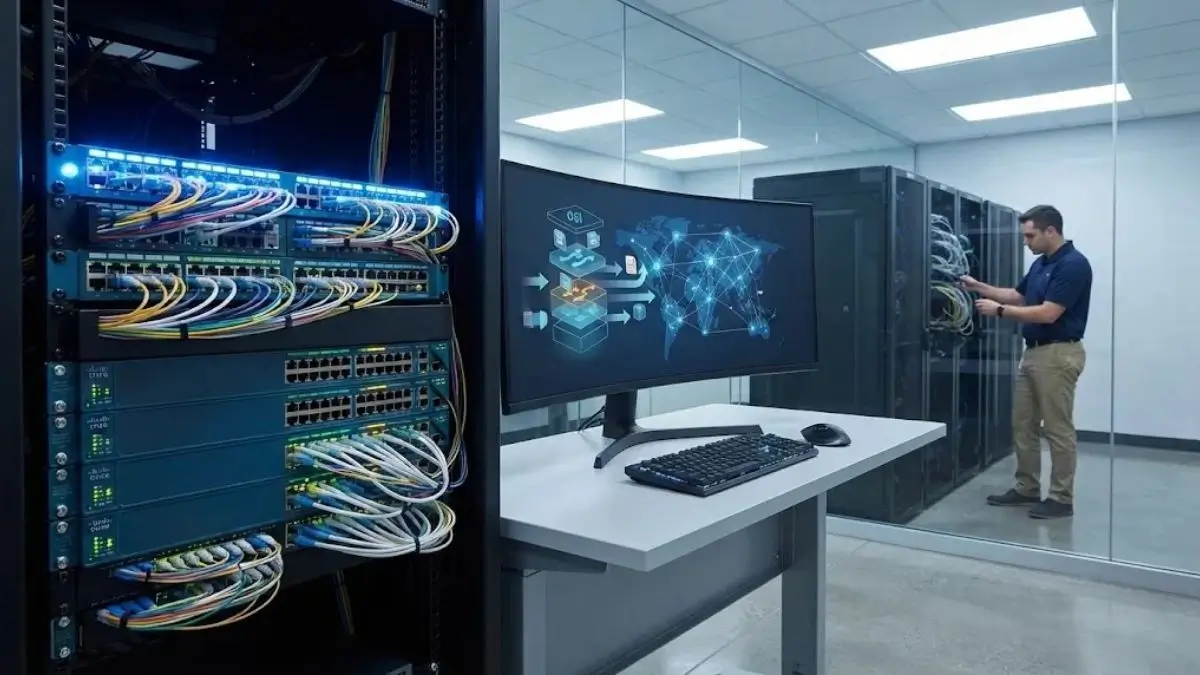
Communication protocols are standardized sets of rules, syntax, semantics, and timing conventions that govern how data is formatted, transmitted, received, and acknowledged between two or more electronic devices across a network. Acting as the shared digital language of information technology, communication protocols ensure that hardware and software systems built by different manufacturers—running on different operating systems—can exchange information reliably, accurately, and securely.
Whether loading a webpage over fiber-optic cables, streaming video across 5G cellular networks, sending an email, or connecting smart sensors within the Internet of Things (IoT), every digital interaction depends on layered communication protocols operating seamlessly behind the scenes.
Core Elements of a Communication Protocol
For any two computing systems to communicate without ambiguity, a protocol must explicitly define three foundational dimensions:
- Syntax: The structural format and byte-level organization of the transmitted data, specifying header fields, payload length, addressing formats, and error-checking bits.
- Semantics: The operational meaning of each bit pattern or control field, dictating how a receiving device interprets instructions, routes packets, or responds to errors.
- Timing (Synchronization): Rules governing transmission speed, sequence ordering, flow control, and timeout intervals so a fast sender does not overwhelm a slower receiver.
Together, these elements handle essential networking functions including encapsulation (wrapping data with protocol headers), routing (selecting optimal network paths), flow control, error detection and correction, and session management.
Historical Evolution of Communication Protocols
Modern networking protocols emerged from mid-twentieth-century efforts to connect incompatible mainframe computers into resilient distributed networks.
Circuit Switching vs. Packet Switching
Early telecommunications relied on circuit switching, which dedicated a continuous physical wire path between two callers for the entire duration of a conversation. In the 1960s, researchers Paul Baran, Donald Davies, and Leonard Kleinrock pioneered packet switching—breaking messages into small, independently routed data blocks (packets) that share network links dynamically and reassemble at the destination.
ARPANET and the Birth of TCP/IP
In 1969, the U.S. Department of Defense launched ARPANET, initially using the Network Control Program (NCP) to connect four university computers. As distinct radio and satellite networks emerged, computer scientists Vint Cerf and Bob Kahn designed the Transmission Control Protocol / Internet Protocol (TCP/IP) suite in 1974. On January 1, 1983, ARPANET officially adopted TCP/IP as its universal standard, establishing the technical foundation of the modern Internet.
The OSI Reference Model and Web Standardization
In 1984, the International Organization for Standardization (ISO) published the Open Systems Interconnection (OSI) seven-layer reference model to provide a vendor-neutral blueprint for network architecture. By the early 1990s, Tim Berners-Lee introduced HTTP (Hypertext Transfer Protocol) on top of TCP/IP, powering the rapid global expansion of the World Wide Web.
Layered Network Architectures: OSI vs. TCP/IP
Rather than building a single monolithic protocol to handle both electrical signals and user applications, engineers divide networking into modular protocol stacks. Each layer performs a specialized task and communicates only with the layers immediately above and below it:
| OSI Layer | Layer Name | Core Function | Representative Protocols |
| Layer 7 | Application | Provides network interfaces directly to end-user software | HTTP/HTTPS, DNS, SMTP, FTP, SSH |
| Layer 6 | Presentation | Handles data translation, compression, and encryption | TLS/SSL, JPEG, MIME |
| Layer 5 | Session | Establishes, manages, and terminates communication dialogues | NetBIOS, RPC, SIP |
| Layer 4 | Transport | Ensures end-to-end delivery, segmentation, and error recovery | TCP, UDP, QUIC |
| Layer 3 | Network | Determines logical addressing and cross-network packet routing | IPv4, IPv6, ICMP, BGP |
| Layer 2 | Data Link | Manages node-to-node framing, physical MAC addressing, and local access | Ethernet (IEEE 802.3), Wi-Fi (IEEE 802.11) |
| Layer 1 | Physical | Transmits raw binary bits as electrical, optical, or radio signals | USB, Fiber Optics, Bluetooth Radio, DSL |
In practical Internet engineering, the seven-layer OSI framework is condensed into the four-layer TCP/IP model (Application, Transport, Internet, and Network Access), where protocols like IP handle global routing and TCP or UDP manage end-to-end transport.
Essential Internet and Application Protocols
Different digital tasks require protocols optimized for either strict reliability or minimal latency:
Core Transport and Routing Protocols
- Internet Protocol (IPv4 and IPv6): Assigns unique numerical IP addresses to devices and routes data packets across interconnected networks. IPv6 uses 128-bit addressing to replace the exhausted 32-bit IPv4 address pool.
- Transmission Control Protocol (TCP): A connection-oriented protocol that guarantees complete, in-order delivery through a three-way handshake, sequence numbering, acknowledgments, and automatic retransmission of lost packets.
- User Datagram Protocol (UDP): A lightweight, connectionless protocol that transmits packets without delivery guarantees or retransmission delays, making it ideal for real-time video calls, online gaming, and live broadcasts.
- QUIC (HTTP/3 Transport): A modern multiplexed transport protocol built over UDP that integrates built-in encryption and faster connection setup to accelerate web browsing on mobile networks.
Web, Naming, and Messaging Protocols
- HTTPS (Hypertext Transfer Protocol Secure): Governs web browser and server communication while encrypting traffic via Transport Layer Security (TLS) to prevent eavesdropping and tampering.
- Domain Name System (DNS): Translates human-readable domain names (such as example.com) into machine-routable IP addresses.
- SMTP, IMAP, and POP3: Standardized protocols governing the sending (SMTP) and retrieval/synchronization (IMAP, POP3) of electronic mail.
- Border Gateway Protocol (BGP): The core inter-domain routing protocol that exchanges path reachability information between major Internet Service Providers (ISPs) and autonomous networks worldwide.
Specialized Industrial, Wireless, and IoT Protocols
Beyond standard web browsing, specialized protocols serve constrained hardware, local devices, and industrial automation:
- Short-Range Wireless Protocols: Wi-Fi (IEEE 802.11) enables high-throughput wireless local area networking; Bluetooth and Bluetooth Low Energy (BLE) connect peripherals and wearables; Zigbee and Thread form low-power mesh networks for smart homes.
- IoT Messaging Protocols: MQTT (Message Queuing Telemetry Transport) and CoAP (Constrained Application Protocol) minimize bandwidth and battery consumption for millions of remote sensors in the Internet of Things.
- Hardware and Industrial Bus Protocols: Inside computers, vehicles, and factories, low-level protocols such as USB, PCIe, I2C, SPI, CAN bus (automotive microcontrollers), and Modbus coordinate rapid communication between sensors, actuators, and microchips.
Security and Modern Challenges in Communication Protocols
Many foundational Internet protocols were originally designed in an era of trusted academic networks, leaving early versions vulnerable to interception, spoofing, and denial-of-service attacks. Modern network engineering addresses these vulnerabilities through cryptographic upgrades—such as HTTPS/TLS 1.3, DNSSEC (to prevent DNS cache poisoning), IPsec (for encrypted Virtual Private Networks), and WPA3 (for wireless security).
As global traffic scales across cloud computing, autonomous vehicles, and billions of connected devices, ongoing protocol research focuses on ultra-low-latency scheduling, post-quantum cryptography resistant to future quantum computers, and automated zero-trust network verification.



2 thoughts on “Communication Protocols”