
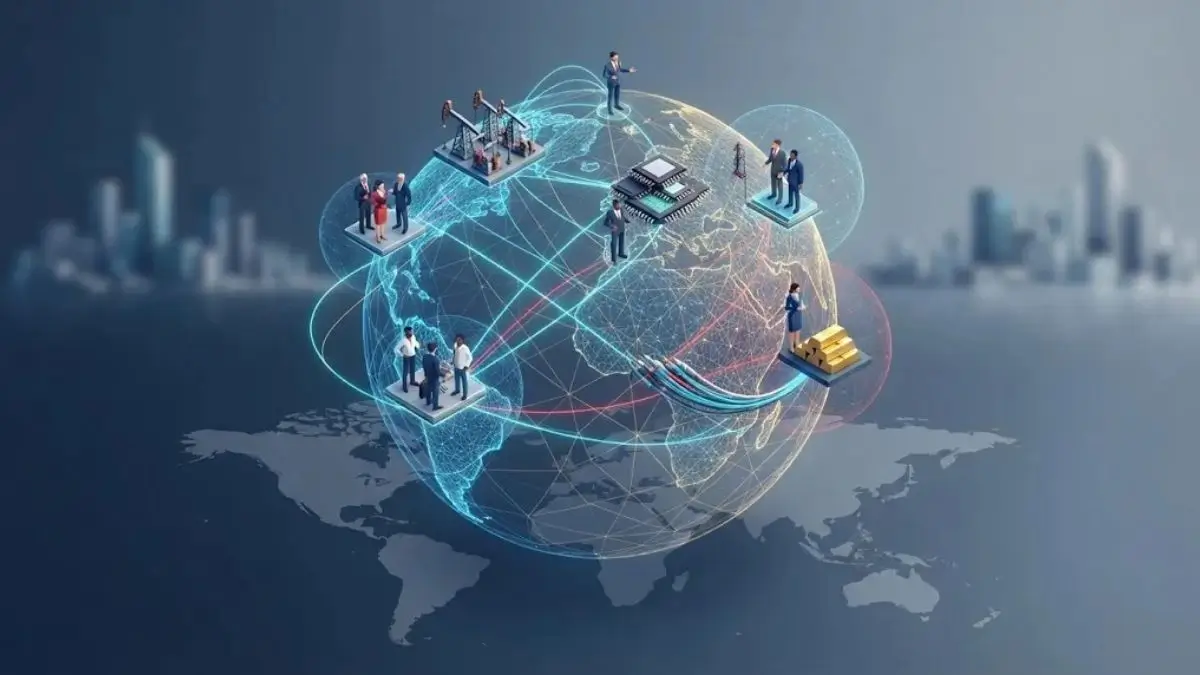
Global geopolitics is the study of how geography, natural resources, economic power, technology, and strategic alliances shape international politics and the foreign policies of sovereign states. Bridging political science, geography, economics, and international relations, geopolitics examines how physical location—such as maritime chokepoints, mountain barriers, river basins, and resource-rich territories—alongside modern digital and industrial capabilities influences competition, cooperation, and the global balance of power.
In an interconnected twenty-first-century world, global geopolitics extends beyond traditional territorial borders to encompass subsea communication networks, semiconductor supply chains, energy transitions, outer space, and international governance institutions.
Core Foundations of Geopolitical Analysis
Geopolitical analysts evaluate state power and international stability through five enduring structural variables:
- Physical and Strategic Geography: A state’s coastline access, navigable waterways, climate, and proximity to critical maritime chokepoints—such as the Strait of Hormuz, the Strait of Malacca, the Suez Canal, and the Panama Canal—directly determine its trade security and naval reach.
- Natural Resources and Energy Security: Control over oil, natural gas, freshwater aquifers, arable land, and critical minerals (such as lithium, cobalt, copper, and rare-earth elements) shapes industrial self-sufficiency and bilateral dependencies.
- Demographics and Economic Capacity: Population size, age distribution, workforce productivity in the labor market, gross domestic product (GDP), and manufacturing scale underpin a nation’s long-term geopolitical resilience.
- Technological and Industrial Sovereignty: Leadership in artificial intelligence, semiconductor microchips, information technology, and aerospace engineering increasingly determines both economic competitiveness and military deterrence.
- Alliances and International Institutions: Bilateral security treaties, regional trade blocs, and multilateral bodies—such as the United Nations (UN), World Trade Organization (WTO), and International Monetary Fund (IMF)—structure diplomatic norms and collective action.
Classical Geopolitical Theories
Modern geopolitical thought developed during the late nineteenth and twentieth centuries through foundational strategic frameworks:
| Theory / Thinker | Core Concept | Strategic Thesis |
| Sea Power Theory (Alfred Thayer Mahan, 1890) | Maritime dominance | Control of global oceans, commercial shipping lanes, and naval bases is the decisive key to world power. |
| Heartland Theory (Halford Mackinder, 1904) | Continental landmass control | Whoever controls Eastern Europe and the resource-rich Eurasian interior (the Heartland) commands the global balance of power. |
| Rimland Theory (Nicholas Spykman, 1942) | Coastal buffer zones | Controlling the densely populated coastal perimeter of Eurasia (the Rimland) contains continental expansion and secures global influence. |
| World-Systems Theory (Immanuel Wallerstein, 1974) | Global economic hierarchy | The world economy is divided into core, semi-periphery, and periphery nations linked by unequal trade and capital flows. |
Evolution of the Global Geopolitical Order
The distribution of global power—known in international relations as polarity—has shifted across distinct historical eras:
The Multipower Colonial and Industrial Era (19th Century–1945)
European empires competed globally for overseas colonies, raw materials, and naval supremacy. Industrialization, railroads, and telegraph communication networks accelerated imperial expansion, ultimately culminating in two devastating World Wars that exhausted traditional European powers.
The Bipolar Cold War Order (1947–1991)
Following World War II, global geopolitics consolidated around two rival superpowers: the United States and the Soviet Union. Characterized by ideological rivalry, nuclear deterrence, proxy conflicts, and competing alliance blocs (NATO and the Warsaw Pact), the Cold War divided much of the world into distinct spheres of influence.
The Unipolar Moment and Globalization (1991–Late 2000s)
The dissolution of the Soviet Union in 1991 left the United States as the sole global superpower. During this period, economic globalization, cross-border supply chains, expansion of the European Union, and the rise of the World Trade Organization integrated emerging economies into a unified global market.
Contemporary Multipolarity and Strategic Competition (2010s–Present)
Today’s international system reflects growing multipolarity, marked by renewed major-power competition alongside the rising diplomatic and economic influence of middle powers across Asia, the Middle East, Latin America, and Africa. Rather than rigid ideological blocs, many states practice multi-alignment, balancing trade, security, and technology partnerships across multiple centers of power.
Key Arenas of Twenty-First-Century Geopolitics
Modern geopolitical competition operates across physical, economic, and technological domains simultaneously:
- Geoeconomics and Supply Chain Resilience: States increasingly deploy tariffs, export controls, sanctions, and industrial subsidies to secure critical manufacturing—particularly in semiconductors, pharmaceuticals, and clean energy technologies—shifting from pure cost efficiency (offshoring) toward regionalized supply chains (friend-shoring).
- Energy Transition and Critical Minerals: As nations decarbonize power grids and transportation, geopolitical leverage is expanding from traditional hydrocarbon producers toward countries that mine and refine lithium, nickel, graphite, and rare-earth elements.
- Digital Infrastructure and Cyberspace: Subsea fiber-optic cables carry the vast majority of intercontinental data traffic, making communication protocols, satellite constellations, cloud data centers, and cybersecurity central to national sovereignty.
- Maritime Chokepoints and Polar Routes: Safeguarding commercial shipping lanes remains vital to global trade, while climate-driven ice retreat in the Arctic is opening new northern shipping corridors and resource claims.
- Outer Space Governance: Orbital slots for communications, navigation (GPS, BeiDou, Galileo, GLONASS), and Earth-observation satellites have become essential infrastructure for both civilian economies and national defense.
Role of International Governance and Diplomacy
Despite intense strategic rivalry, global geopolitics relies on diplomatic frameworks to manage shared transnational challenges—including climate change, pandemic preparedness, nuclear non-proliferation, financial stability, and maritime law (such as the United Nations Convention on the Law of the Sea, UNCLOS). Effective diplomacy balances national security interests with institutional mechanisms that prevent miscalculation and sustain global economic stability.



One thought on “Global Geopolitics”