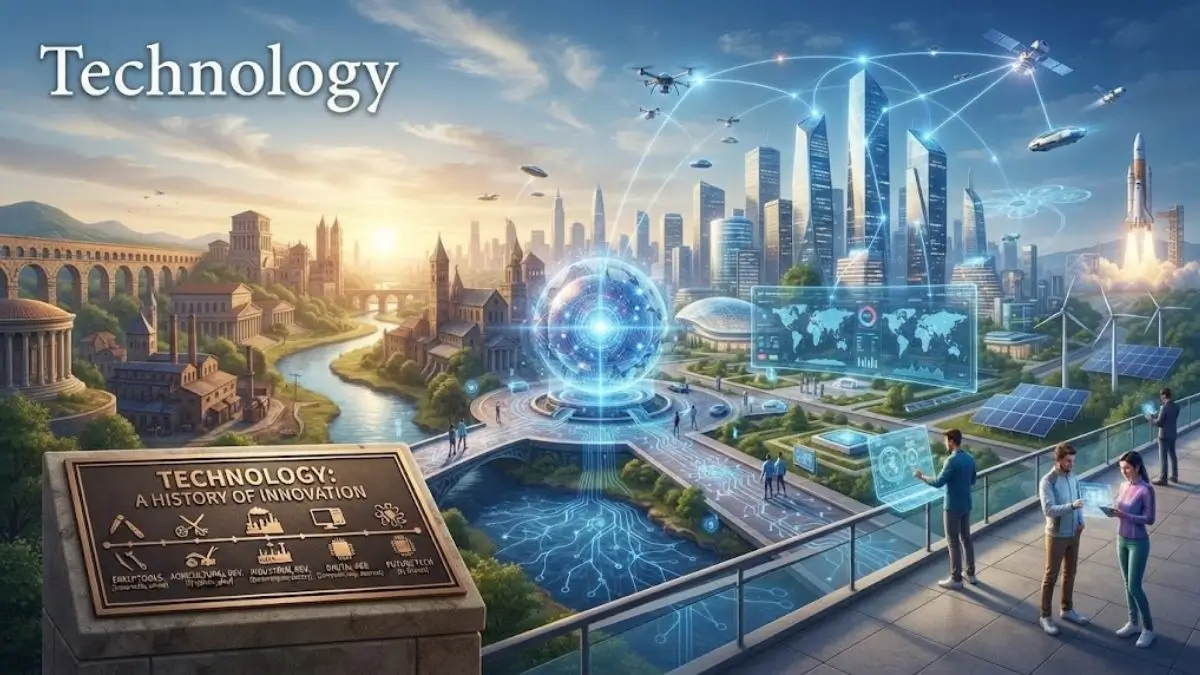
Technology is the application of scientific knowledge to practical aims, or the manipulation of the human environment to adapt, control, and improve it. The term comes from the Greek words techne (meaning art or craft) and logia (study). While modern usage often equates technology with advanced electronics, computers, and machinery, its historical and philosophical scope is much broader, encompassing any human-made tool or technique designed to solve problems.
1. History of Technology
The history of technology is deeply intertwined with the history of human evolution and civilization. Each major historical era has been defined by the technological leaps made by society:
- Early Technology: The invention of simple stone tools enabled early humans to hunt, process food, and harness fire, marking the earliest milestones in human survival and adaptation.
- The Agricultural Revolution: The invention of the wheel and early farming techniques allowed humans to transition from nomadic hunter-gatherer lifestyles to settled agrarian communities, laying the foundation for modern civilization.
- The Industrial Revolution: Beginning in the 18th century, the invention of the steam engine and mechanized manufacturing transformed production. Human and animal labor was largely replaced by machines, revolutionizing transportation, commerce, and industry.
- The Information Age: The late 20th and early 21st centuries introduced computers, the internet, and digital communication, shrinking the globe into a hyper-connected “global village.”
2. Major Types of Technology
Technology can be categorized into various domains based on its application and function:
- Communication Technology: Tools like smartphones, telecommunication networks, and the internet that facilitate instant information sharing across vast distances.
- Medical Technology: Pharmaceuticals, diagnostic imaging (such as MRI and X-rays), and advanced surgical equipment that have drastically improved human health, diagnostics, and life expectancy.
- Industrial and Manufacturing Technology: Automated machinery, robotics, and assembly lines that mass-produce goods efficiently and with high precision.
- Agricultural Technology: Advanced machinery, automated irrigation systems, and genetically optimized seeds designed to secure food supplies for a growing global population.
3. Impact on Society and Civilization
Technology and human society share a reciprocal relationship; society drives technological innovation, and in turn, technology reshapes society:
- Benefits: Technology has vastly improved quality of life. It has bridged geographical divides, democratized access to education and healthcare, and dramatically increased economic productivity.
- Challenges: Rapid technological advancement has also introduced complex challenges, including environmental pollution, the depletion of natural resources, workforce displacement due to automation, and psychological impacts associated with digital over-reliance.
4. Future Outlook
Today, technology stands at a transformative frontier driven by Artificial Intelligence (AI), Biotechnology, and Quantum Computing. These emerging fields are poised to redefine human capability, paving the way for autonomous systems, sustainable energy breakthroughs, and advanced space exploration.
Ultimately, technology represents the pinnacle of human ingenuity—a continuous endeavor to overcome limitations and shape a more capable world, provided it is directed toward sustainable and ethical ends.