
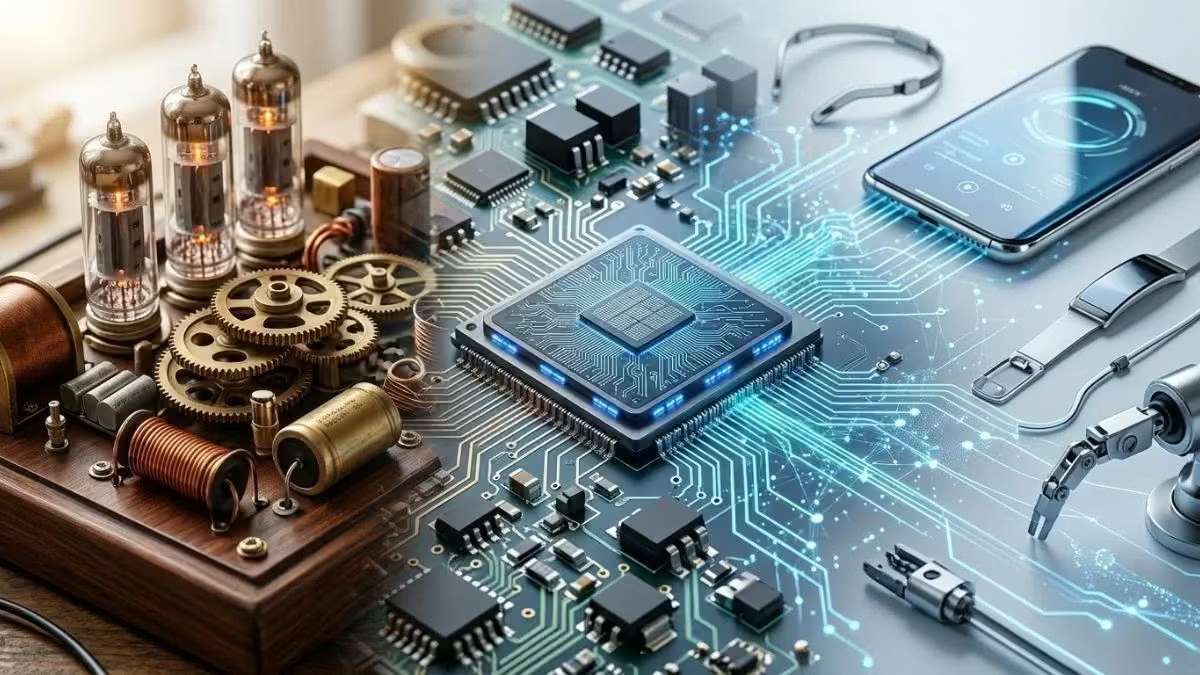
Electronics is the branch of physics, engineering, and technology that deals with the controlled flow of electrons and other charge carriers through semiconductors, vacuum tubes, conductors, and circuits. From the smartphones in our pockets and the laptops on our desks to medical imaging devices, electric vehicles, and satellite networks, electronics forms the invisible intelligence behind virtually every modern convenience.
While traditional electrical engineering focuses primarily on generating and distributing large-scale electrical power, electronics specializes in manipulating tiny electrical currents to process information, transmit signals, amplify sound, and control automated systems. Understanding how electronics works, how it evolved, and the core components inside everyday devices provides essential insight into the technology shaping the 21st century.
This comprehensive guide explores the definition, history, core components, major branches, and future trends of electronics.
Defining What Makes Electronics Unique
At its core, electronics is about control and information. In an ordinary electrical circuit—such as a simple light switch connected to a bulb—electricity is used strictly to deliver energy (heat and light). In an electronic circuit, however, electrical currents are precisely shaped, switched, and amplified to represent data, audio, video, or control commands.
This capability relies on active components (like transistors and integrated circuits) that can regulate the flow of electricity using another electrical signal. Because electronic signals can switch on and off billions of times per second, modern electronic devices can perform complex mathematical calculations, store vast libraries of information, and communicate wirelessly across the globe in milliseconds.
The History and Evolution of Electronics
The rapid rise of electronics over the past century represents one of the fastest technological transformations in human history.
1. The Vacuum Tube Era (Early 20th Century)
Modern electronics began in the early 1900s with the invention of the diode and triode vacuum tubes. These glass bulbs controlled electron flow in a vacuum, making it possible to amplify weak radio signals and build the first radios, televisions, radar systems, and early room-sized computers like ENIAC. While revolutionary, vacuum tubes were bulky, fragile, consumed immense electricity, and generated heavy heat.
2. The Invention of the Transistor (1947)
In 1947, physicists at Bell Labs invented the transistor—a tiny solid-state semiconductor device capable of amplifying and switching electrical signals without glass bulbs or heated filaments. Transistors were smaller, faster, far more reliable, and vastly more energy-efficient than vacuum tubes, paving the way for portable radios and compact electronics.
3. The Integrated Circuit and Microprocessor Revolution (1958–1970s)
In the late 1950s, engineers Jack Kilby and Robert Noyce independently developed the integrated circuit (IC), or microchip, which placed multiple transistors, resistors, and capacitors onto a single piece of silicon. By 1971, the arrival of the first commercial microprocessor packed an entire computer central processing unit (CPU) onto one chip, sparking the personal computer revolution.
4. Miniaturization, Wireless Connectivity, and AI Hardware (1980s–Present)
Guided by Moore’s Law—the observation that transistor counts on microchips double roughly every two years—modern chips now contain tens of billions of microscopic transistors measured in nanometers. Combined with lithium-ion batteries, high-resolution displays, and wireless standards like Wi-Fi, Bluetooth, and 5G, electronics shrank from desktop towers into smartphones, wearables, and specialized AI accelerators.
Core Electronic Components and How They Work
Every electronic device—no matter how advanced—is built from combinations of fundamental passive and active components mounted on a Printed Circuit Board (PCB):
Passive Components (Do Not Require External Power to Control Signals)
- Resistors: Limit and regulate the flow of electrical current, protecting sensitive parts and dividing voltage levels.
- Capacitors: Store and release electrical energy temporarily, smoothing out power fluctuations and filtering signals.
- Inductors: Coils of wire that store energy in a magnetic field, commonly used in power supplies, transformers, and radio tuning circuits.
Active Components (Control and Amplify Electrical Signals)
- Diodes: Allow current to flow in only one direction, essential for converting alternating current (AC) into direct current (DC). Light-Emitting Diodes (LEDs) also emit light when current passes through them.
- Transistors: The fundamental building blocks of modern electronics, acting either as microscopic electronic switches (representing binary 1s and 0s) or signal amplifiers.
- Integrated Circuits (ICs): Complete miniature circuits etched onto silicon wafers, ranging from simple timers and memory chips to complex processors and graphics units.
- Sensors and Actuators: Sensors convert physical inputs (light, temperature, motion, sound) into electrical signals, while actuators convert electrical signals back into physical motion or sound (such as speakers and motors).
Analog vs. Digital Electronics
Electronic systems generally process information in one of two ways:
- Analog Electronics: Deals with continuous signals that vary smoothly over time, mirroring natural phenomena like sound waves, temperature, or light intensity. Microphones, audio amplifiers, and radio receivers rely heavily on analog circuits.
- Digital Electronics: Represents information using discrete binary values—1s and 0s (high voltage and low voltage). Computers, smartphones, digital cameras, and calculators operate using digital logic gates because binary signals are highly resistant to noise, easy to store, and ideal for rapid computation.
Most modern devices are mixed-signal systems, using Analog-to-Digital Converters (ADCs) and Digital-to-Analog Converters (DACs) to bridge the physical world with digital processors.
Major Branches and Applications of Electronics
Electronics powers nearly every sector of modern industry and daily life:
1. Consumer Electronics
Smartphones, laptops, smart TVs, gaming consoles, wireless earbuds, and smart home appliances designed for everyday communication, entertainment, and convenience.
2. Telecommunications and Networking
Routers, fiber-optic transceivers, cellular base stations, and communication satellites that enable global internet access, streaming, and instant messaging.
3. Industrial Automation and Robotics
Programmable Logic Controllers (PLCs), precision motor drives, factory sensors, and robotic arms that automate manufacturing, packaging, and quality inspection.
4. Automotive and Aerospace Electronics
Modern vehicles rely on dozens of electronic control units (ECUs) for engine management, anti-lock braking, battery management in electric vehicles (EVs), LiDAR, radar, and autonomous driving systems.
5. Medical Electronics (Biomedical Engineering)
Life-saving diagnostic and therapeutic equipment, including MRI and CT scanners, pacemakers, ultrasound machines, ECG monitors, and wearable health trackers.
The Future of Electronics
As traditional silicon scaling approaches physical atomic limits, researchers and engineers are pioneering the next wave of electronic innovation:
- AI-Specialized Chips (NPUs and Neuromorphic Computing): Hardware designed specifically to run artificial intelligence models locally with minimal battery drain.
- Flexible and Wearable Electronics: Bendable OLED displays, electronic skin patches, and smart textiles capable of continuous health monitoring.
- Quantum Electronics: Processors harnessing quantum mechanics to solve complex molecular, cryptographic, and optimization problems beyond the reach of classical computers.
- Sustainable and Green Electronics: Advances in recyclable circuit boards, lead-free soldering, modular device repairability, and e-waste recovery to reduce environmental impact.
Frequently Asked Questions (FAQs)
What is the difference between electrical and electronic devices?
Electrical devices convert electricity directly into another form of energy—such as heat, light, or mechanical motion (e.g., an incandescent bulb, toaster, or simple fan). Electronic devices manipulate electrical currents to process data, amplify signals, or make automated decisions (e.g., a smartphone, television, or computer).
Why is silicon used in almost all electronic chips?
Silicon is an abundant semiconductor—meaning its electrical conductivity can be precisely controlled by adding tiny amounts of other elements (a process called doping). It also forms a stable natural oxide layer ideal for insulating microscopic circuits.
What is a Printed Circuit Board (PCB)?
A PCB is the flat, rigid (or flexible) board inside electronic devices that mechanically supports components and connects them electrically using thin etched copper pathways instead of messy loose wires.
Conclusion
Electronics has transformed how humanity communicates, works, travels, and understands the world. What began with fragile glass vacuum tubes a century ago has evolved into microscopic silicon architectures powering artificial intelligence, clean energy grids, and global connectivity. As electronic systems become faster, smaller, and more sustainable, they will continue to serve as the driving force behind future technological breakthroughs.


6 thoughts on “Electronics”