When looking at the technological landscape of the modern world—from the smartphones in our pockets to the vast cloud servers powering artificial intelligence—nearly every single processor traces its lineage back to a single foundational group. In the mid-1950s, a bold mutiny against a Nobel laureate birthed what would become known as The Traitorous Eight.
This group of brilliant young scientists and engineers did not just start a company; they accidentally catalyzed the semiconductor revolution and established the blueprint for modern Silicon Valley culture, venture capital, and entrepreneurial spin-offs.
1. The Backdrop: Shockley and the Birth of Silicon
To understand the Traitorous Eight, one must look back to 1956 in Mountain View, California. William Shockley, co-inventor of the transistor and co-recipient of the 1956 Nobel Prize in Physics, decided to leave the East Coast to establish his own enterprise: Shockley Semiconductor Laboratory.
Shockley possessed a brilliant scientific mind, but he was notoriously tyrannical, paranoid, and erratic as a manager. Eager to build the world’s first commercial silicon-based semiconductor device (moving away from fragile and heat-sensitive germanium), Shockley scoured top-tier universities—particularly MIT and Caltech—to recruit the absolute sharpest young minds in physics and engineering.
Among those recruited were eight exceptional young men who would soon change history:
- Robert Noyce
- Gordon Moore
- Julius Blank
- Victor Grinich
- Jean Hoerni
- Eugene Kleiner
- Jay Last
- Sheldon Roberts
2. The Mutiny: Why They Walked Out
By 1957, working under William Shockley had become intolerable. Shockley’s management style included public humiliation, lie detector tests for employees over minor workplace incidents, and a refusal to pursue promising research paths (such as the planar transistor process championed by Jean Hoerni).
Frustrated, the group appealed to Arnold Beckman, the founder of Beckman Instruments (Shockley’s financial backer), demanding that Shockley be replaced. When Beckman refused, the eight engineers made a radical decision: they would walk out en masse.
Shockley was deeply hurt and infuriated by the departure, famously labeling them the “Traitorous Eight.” In an era when corporate loyalty was absolute and engineers rarely abandoned their employers, this mass defection sent shockwaves through American industry.
3. Funding and the Birth of Fairchild Semiconductor
With no financial backing and facing an uncertain future, the group turned to Arthur Rock, a young investment banker at Hayden, Stone & Co. in New York. Rock drafted a visionary proposal and helped them secure venture backing from Sherman Fairchild, an industrialist and inventor.
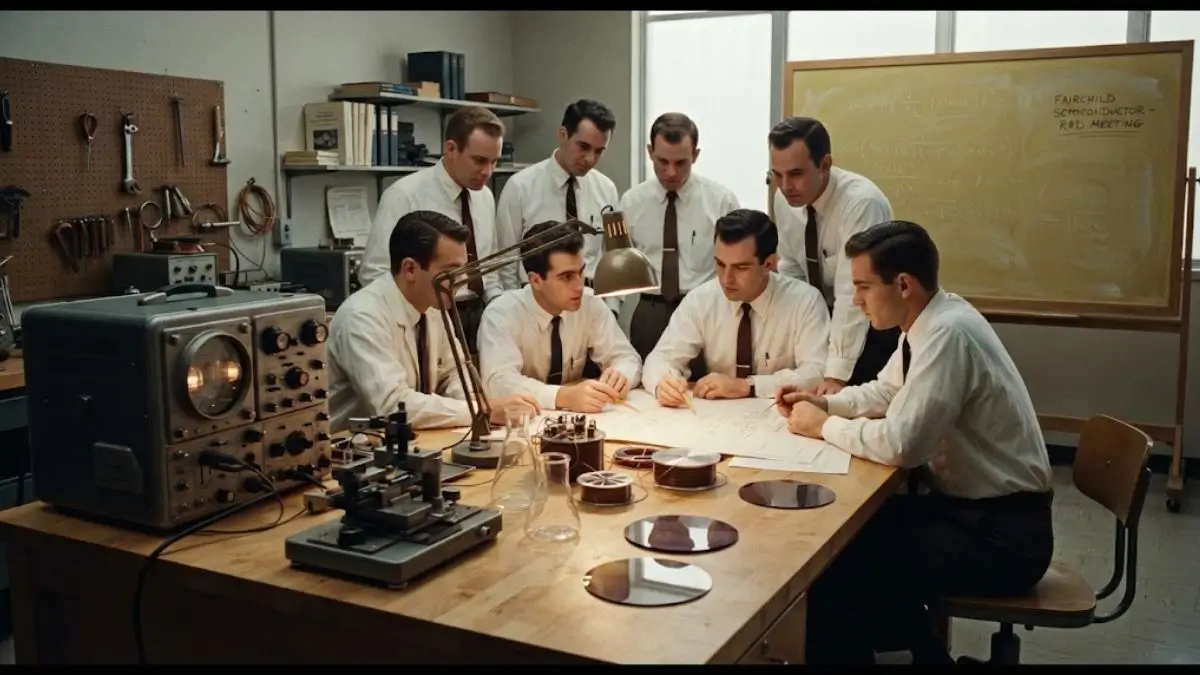
In late 1957, they founded Fairchild Semiconductor in Mountain View, California.
The gamble paid off spectacularly:
- The Planar Process: Jean Hoerni developed the “planar process,” which allowed transistors to be manufactured on a flat silicon wafer in a single plane. This single invention solved reliability issues and made mass production cheap and commercially viable.
- The Integrated Circuit: Concurrently, Robert Noyce independently invented the integrated circuit (microchip) in 1958, packing multiple transistors onto a single piece of silicon. (Jack Kilby of Texas Instruments developed a similar concept around the same time, leading to a legendary patent shared history).
Fairchild Semiconductor quickly grew into a powerhouse, fueling the nascent electronics industry and supplying microchips for the U.S. space program and early computers.
4. The “Fairchild Children” and the Silicon Valley Spinoff Culture
The most profound legacy of the Traitorous Eight was not just Fairchild itself, but what happened when they and their employees eventually began to leave.
Because California law prohibited non-compete agreements (unlike states like New York), tech talent was legally free to leave a company and start a competing venture. The Traitorous Eight pioneered a corporate ecosystem of continuous spinoffs:
- Intel Corporation: In 1968, Robert Noyce and Gordon Moore left Fairchild to found Intel, focusing on semiconductor memory and eventually inventing the microprocessor.
- AMD (Advanced Micro Devices): Founded in 1969 by Jerry Sanders, a former marketing executive at Fairchild.
- Venture Capital Roots: Eugene Kleiner left to co-found Kleiner Perkins, one of the most legendary venture capital firms in Silicon Valley history, which later funded Amazon, Google, and Genentech.
By the 1970s, nearly every semiconductor firm in the Santa Clara Valley could trace its genealogical roots back to Fairchild Semiconductor. A map of these spinoff companies looked like a family tree, earning the region the permanent nickname “Silicon Valley.”
Legacy and Historical Impact
The Traitorous Eight did more than advance physics and engineering; they shattered the old corporate mold of lifelong company loyalty. They proved that restless innovation, risk-taking, venture capital-backed startups, and employee mobility could build industries faster than rigid corporate hierarchies. Today, every tech startup operating out of a garage or venture-backed office space is a direct descendant of the risk taken by those eight young engineers in 1957.