
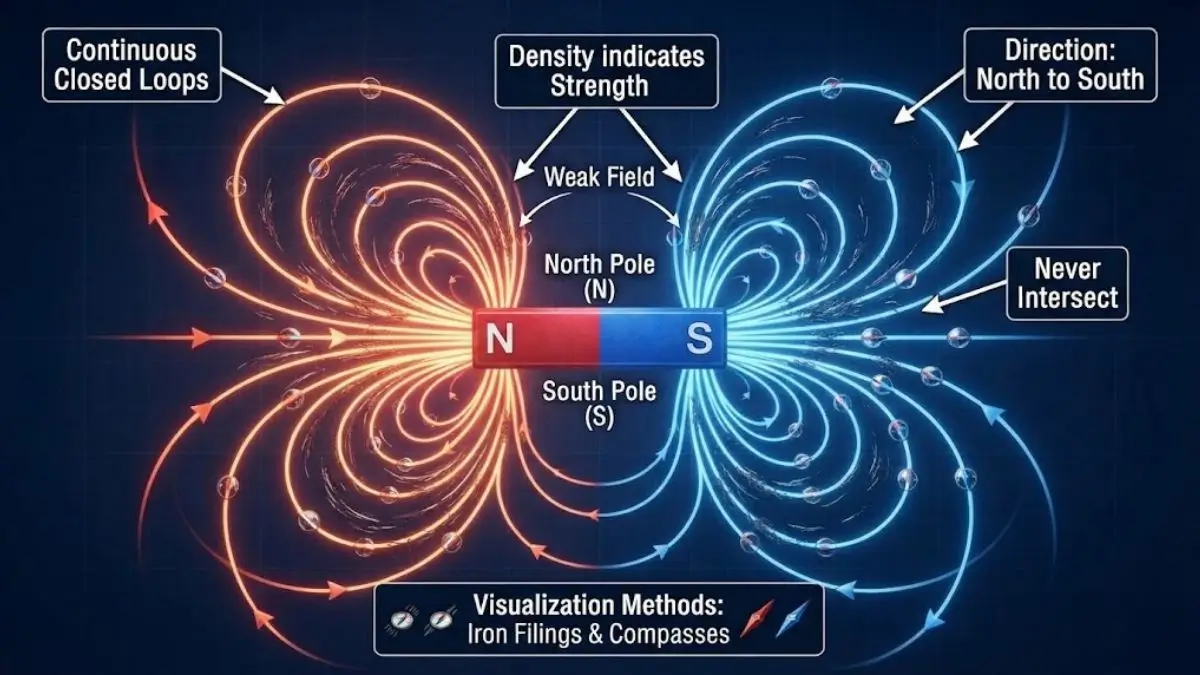
Magnetic field lines are invisible conceptual lines used to visualize the direction and strength of a magnetic field. While we cannot see magnetic forces with the naked eye, these imaginary lines map out how a magnetic force behaves in the space surrounding a magnet or an electric current.
Key Characteristics of Magnetic Field Lines
- Direction of Flow: Outside a magnet, field lines always emerge from the North pole and loop around to enter the South pole. Inside the magnet, they complete the circuit by moving from South to North.
- Density and Strength: The closeness or density of the lines indicates the strength of the magnetic field. Where the lines are crowded together (usually near the poles), the magnetic field is strongest; where they spread apart, the field is weaker.
- Continuous Closed Loops: Magnetic field lines never start or end abruptly; they always form continuous, unbroken closed loops.
- No Intersections: Two magnetic field lines can never intersect one another. If they did, it would mean the magnetic field has two different directions at a single point, which is physically impossible.
How to Visualize Magnetic Field Lines
- Iron Filings Experiment: If you sprinkle iron filings over a piece of paper placed on top of a bar magnet and gently tap the paper, the filings naturally align themselves along the magnetic field lines, creating visible patterns.
- Compass Needle Method: A small plotting compass placed near a magnet will point in the direction of the magnetic field line at that exact spot, allowing you to trace the path from pole to pole.
Did You Know? The concept of “lines of force” was popularized by the pioneering physicist Michael Faraday, who used them to conceptualize how invisible forces interact across empty space!



One thought on “Understanding Magnetic Field Lines: A Detailed Guide”