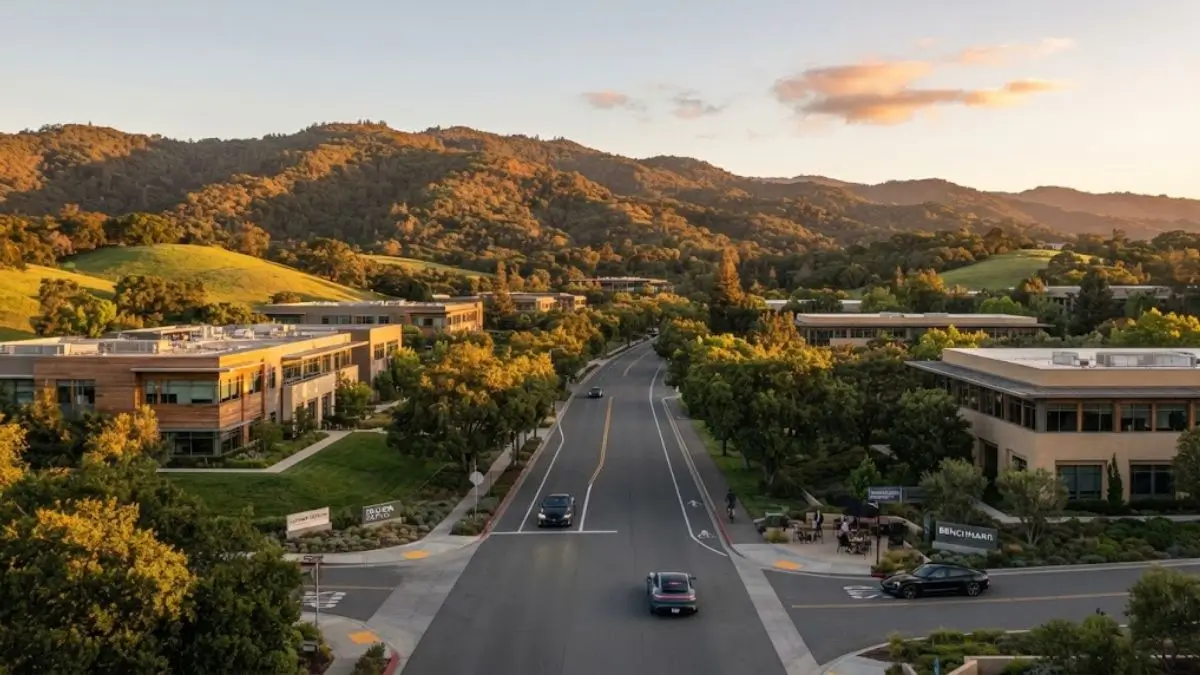
When people talk about the capital fueling Silicon Valley’s most disruptive technologies, they are usually referring to a specific stretch of asphalt in Menlo Park, California: Sand Hill Road.
While Wall Street is universally recognized as the financial heart of traditional banking and public stock markets, Sand Hill Road is the undisputed global capital of venture capital (VC). For decades, this unassuming suburban avenue has served as the launchpad for iconic tech giants, including Apple, Google, Amazon, Meta, and Oracle.
1. Geographic Origins and the Stanford Connection
Sand Hill Road runs west from Interstate 280 toward the foothills of the Santa Cruz Mountains, cutting right past the campus of Stanford University.
- The Academic Proximity: The rise of Sand Hill Road as a financial hub is deeply intertwined with Stanford’s engineering and computer science departments. In the mid-20th century, university leadership actively encouraged commercializing research.
- The Move Out of Palo Alto: Originally, early venture pioneers like Arthur Rock operated out of traditional downtown offices. However, as the local tech ecosystem exploded in the late 1970s and 1980s, investors sought closer proximity to both Stanford’s talent pipeline and the emerging corporate parks of Silicon Valley.
- Strategic Location: Situated directly adjacent to Menlo Park and Stanford, Sand Hill Road provided the ideal geographic middle ground for investors to meet with university researchers, corporate attorneys, and startup founders.
2. The Birthplace of Legendary Venture Capital Firms
By the late 1970s and 1980s, legendary venture capital firms began establishing their headquarters along this specific corridor, turning ordinary office parks into financial powerhouses. Notable firms that call or have called Sand Hill Road home include:
- Kleiner Perkins: Founded in 1972, this pioneering firm backed early giants like Genentech, Amazon, and Google.
- Sequoia Capital: Established in 1972 by Don Valentine, Sequoia funded Apple, Cisco, Oracle, and WhatsApp, among countless others.
- Benchmark: Known for early-stage bets on companies like eBay, Twitter, and Uber.
The dense concentration of these firms created a powerful network effect. Founders did not need to travel across the country to pitch investors; they could walk or drive down a single street to meet multiple top-tier venture partners in a single afternoon.
3. The Anatomy of a Venture Capital Deal
Sand Hill Road institutionalized the modern venture capital model, transforming how high-risk, high-reward startups are funded and scaled:
- Seed and Series Funding: Rather than relying on traditional bank loans—which are poorly suited for pre-revenue software startups—entrepreneurs on Sand Hill Road trade equity for capital, mentorship, and strategic operational guidance.
- The “Term Sheet” Culture: The offices lining this street became famous for high-stakes negotiations, rapid scaling strategies, and the incubation of garage-born concepts into multi-billion-dollar corporations.
- The Ecosystem Support: Alongside venture funds, Sand Hill Road attracted an elite support network of corporate law firms, executive search agencies, and public relations consultants tailored specifically to early-stage tech companies.
4. Evolution and the Modern Era
While Silicon Valley has decentralized significantly in recent years—with major venture firms opening offices globally in New York, Austin, Miami, and international tech hubs—Sand Hill Road remains the historic spiritual and psychological center of venture capital.
Despite rising real estate costs and periodic shifts toward remote work, a physical address on Sand Hill Road still carries immense prestige, symbolizing proximity to the most influential kingmakers in global technology.