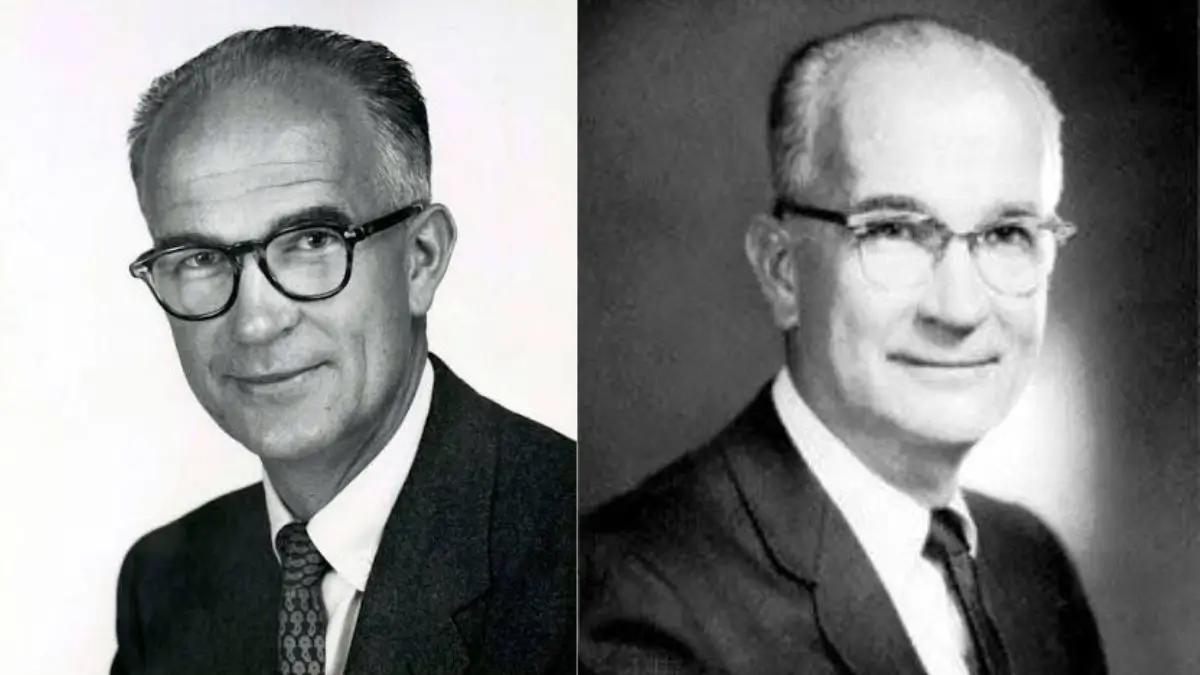
In the history of science and technology, few figures evoke such a stark contradiction as William Shockley. On one hand, he was a brilliant physicist who co-invented the transistor—an invention that fundamentally ushered in the digital age, earned him a Nobel Prize, and laid the literal groundwork for modern computing. On the other hand, his tyrannical management style alienated his brightest minds, and his later controversial forays into eugenics and race science left a deeply troubled social legacy.
Understanding William Shockley is essential to understanding both the brilliance and the complex human flaws embedded in the history of Silicon Valley.
1. Early Life, Education, and World War II
Born in London in 1910 to American mining engineer parents, William Bradford Shockley grew up in Palo Alto, California. He showed an early and exceptional aptitude for physics and mathematics, earning his undergraduate degree from Caltech in 1932 and his Ph.D. from MIT in 1936.
Following his doctorate, Shockley joined the prestigious Bell Telephone Laboratories (Bell Labs). During World War II, his scientific talents were directed toward the war effort. He served as the research director of the Antisubmarine Warfare Operations Research Group, applying operations research and advanced physics to military strategy, for which he received the Medal for Merit from the Secretary of War in 1946.
2. The Invention of the Transistor at Bell Labs
Following the war, Shockley returned to Bell Labs, where he co-headed a solid-state physics research group alongside physicist John Bardeen and experimentalist Walter Brattain. At the time, computers and electronic systems relied on bulky, fragile, and power-hungry vacuum tubes.
- The Breakthrough: After months of intense experimentation, Shockley’s team successfully built the first working point-contact transistor in December 1947. Shortly after, Shockley independently conceptualized the improved junction transistor, which became the standard for industrial manufacturing.
- The Nobel Prize: In 1956, Shockley, Bardeen, and Brattain were jointly awarded the Nobel Prize in Physics for their revolutionary research on semiconductors and the discovery of the transistor effect.
Despite sharing the Nobel glory, relations within the team soured. Shockley felt aggrieved that he was initially excluded from co-authoring certain foundational patent applications and grew increasingly authoritarian, driving a wedge between himself and his co-inventors.
3. Shockley Semiconductor and the “Traitorous Eight”
In 1956, seeking to commercialize his semiconductor breakthroughs, Shockley left Bell Labs and the East Coast to establish Shockley Semiconductor Laboratory in Mountain View, California—right in his old stomping grounds of the Santa Clara Valley.
Determined to build the world’s first silicon-based transistors, Shockley recruited some of the sharpest young engineering and physics graduates from top universities. However, his management style proved disastrously erratic:
- He subjected employees to lie detector tests over minor office accidents.
- He publicly humiliated staff, monitored their phone calls, and obsessively micromanaged research.
- He refused to pursue promising technological paths, such as the planar transistor.
By 1957, a group of eight brilliant young engineers—including Robert Noyce and Gordon Moore—had reached their breaking point. When company backer Arnold Beckman refused to remove Shockley, the group walked out en masse. A furious Shockley branded them the “Traitorous Eight.” That breakaway group went on to found Fairchild Semiconductor, eventually giving birth to Intel and cementing the region’s status as Silicon Valley.
4. Later Years, Controversial Theories, and Legacy
As Shockley’s commercial ventures struggled, he shifted his academic focus to Stanford University, where he became a professor of engineering and applied science. However, the final decades of his life were entirely overshadowed by a slide into scientific racism and eugenics.
During the late 1960s and 1970s, Shockley advanced controversial, discredited theories arguing that genetic factors explained differences in intelligence among racial groups. He advocated for voluntary sterilization programs for individuals with lower IQ scores, claiming human civilization faced a “dysgenic” decline.
While his scientific peers overwhelmingly condemned his pseudoscientific sociological theories, Shockley remained defiant until his death in 1989, even donating his sperm to a high-IQ repository (the Repository for Germinal Choice).
Summary and Historical Impact
William Shockley remains one of the most paradoxical figures in modern history. Without his brilliance at Bell Labs, the electronic and digital revolution would have been delayed by decades. Yet, his abrasive personality accidentally birthed the entrepreneurial spin-off culture of Silicon Valley when his best engineers fled him, and his later years served as a cautionary tale of a brilliant intellect misapplied outside its domain.