
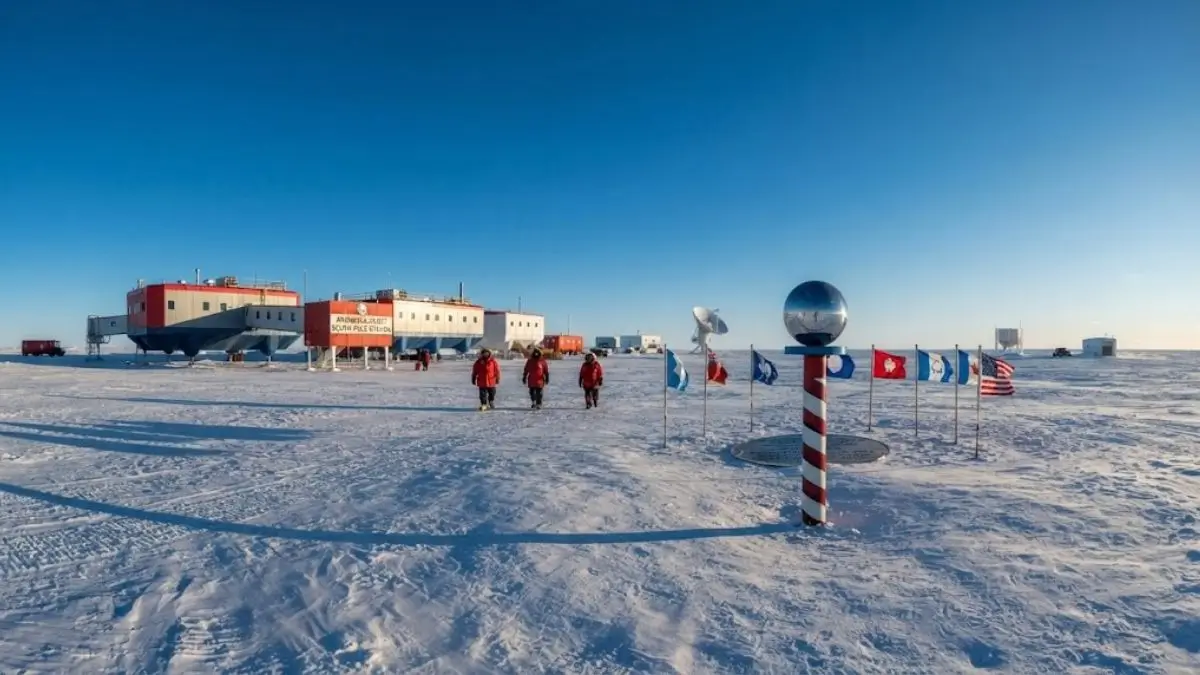
The South Pole, formally known as the Geographic South Pole, is the southernmost point on the surface of the Earth. It lies diametrically opposite to the North Pole and is situated on the vast, icy continent of Antarctica.
Key Geographical and Environmental Facts
- Location on Solid Land: Unlike the North Pole, which is situated on shifting sea ice in the middle of the Arctic Ocean, the South Pole rests on a thick, stable ice sheet atop the continent of Antarctica.
- High Altitude: Because of the massive thickness of the ice sheet beneath it, the South Pole sits at an altitude of approximately 2,835 meters (9,301 feet) above sea level.
- The Coldest Place on Earth: The South Pole experiences an extreme polar desert climate. It is one of the coldest and driest places on the planet. Winter temperatures frequently plummet below $-60^\circ\text{C}$ ($-76^\circ\text{F}$), and summer temperatures rarely rise above $-25^\circ\text{C}$ ($-13^\circ\text{F}$).
- Six Months of Day and Night: Due to Earth’s axial tilt, the South Pole experiences only one sunrise and one sunset each year. The sun stays continuously above the horizon for six months (spring and summer) and remains below the horizon for six months of continuous darkness (autumn and winter).
Scientific Research: The Amundsen-Scott Station
The South Pole is home to the Amundsen–Scott South Pole Station, a permanent scientific research facility operated by the United States. Established in 1956, it supports scientists year-round studying fields ranging from astrophysics and meteorology to seismology and glaciology, taking advantage of the clear, pollution-free atmosphere.
History of Exploration
Reaching the South Pole was the pinnacle of the “Heroic Age of Antarctic Exploration”:
- The Race to the Pole: A legendary and fierce race unfolded in 1911 between Norwegian explorer Roald Amundsen and British explorer Robert Falcon Scott.
- First to Arrive: Roald Amundsen and his team successfully reached the South Pole first on December 14, 1911, utilizing skis and dog sleds.
- Scott’s Arrival: Robert Falcon Scott and his team reached the pole a month later on January 17, 1912, only to find the Norwegian flag already flying. Tragically, Scott and all members of his team perished on their return journey.
Did You Know? Because the massive ice sheet resting on Antarctica is constantly flowing and moving toward the sea (by about 10 meters per year), the actual marker representing the geographic South Pole has to be physically relocated and re-ceremonialized every year on New Year’s Day!



4 thoughts on “South Pole”