
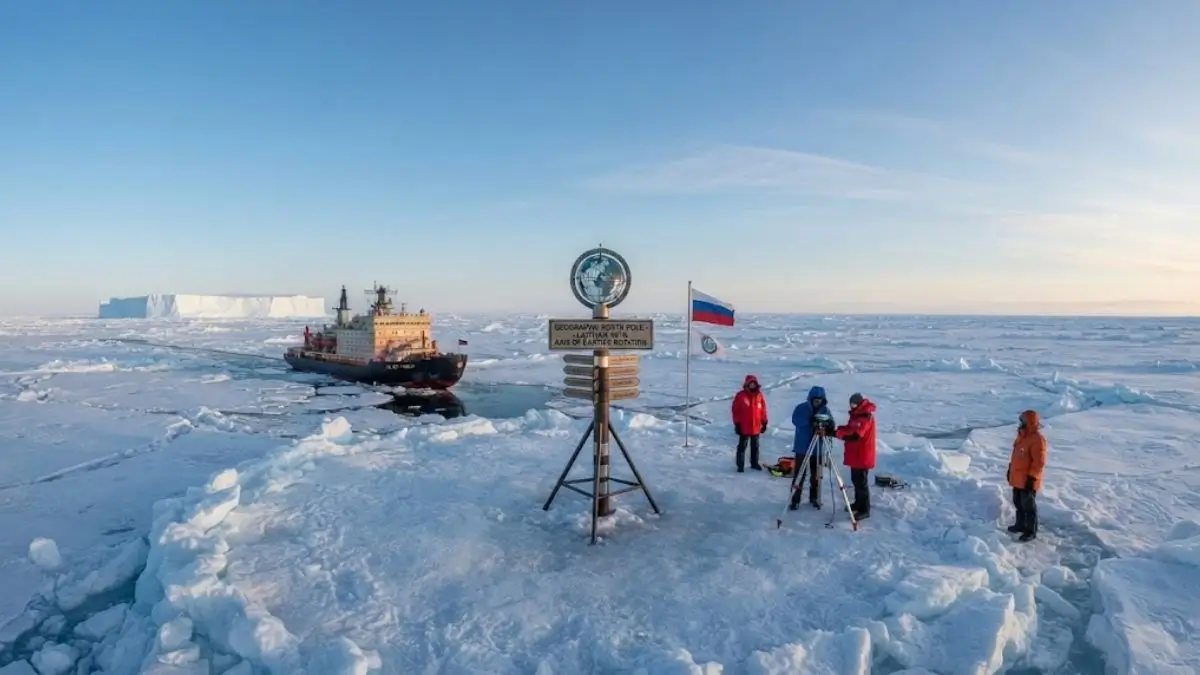
The North Pole, also known as the Geographic North Pole or Terrestrial North Pole, is defined as the point in the Northern Hemisphere where Earth’s axis of rotation meets its surface. It stands as the northernmost point on Earth, lying diametrically opposite to the South Pole.
Key Geographical and Environmental Facts
- Fixed Location: Unlike the Magnetic North Pole, which constantly shifts due to changes in Earth’s molten core, the Geographic North Pole is fixed at latitude 90 North. All lines of longitude converge there, meaning every direction points south.
- The Arctic Ocean: Unlike the South Pole, which sits on a massive, elevated landmass (Antarctica), the North Pole is located in the middle of the Arctic Ocean. The sea here is permanently covered by a shifting, drifting cap of sea ice that is typically 2 to 3 meters thick.
- Extreme Climate: The region experiences extreme polar climates. Winter temperatures at the North Pole can plummet to around $-40^\circ\text{C}$ ($-40^\circ\text{F}$) or lower, while summer temperatures hover right around the freezing point ($0^\circ\text{C}$ or $32^\circ\text{F}$).
- The Midnight Sun and Polar Night: Due to Earth’s axial tilt, the North Pole experiences only one sunrise and one sunset per year. The sun remains continuously above the horizon for six months (continuous daylight from the vernal equinox to the autumnal equinox) followed by six months of continuous darkness (polar night).
Geographic North Pole vs. Magnetic North Pole
It is essential to distinguish between the two distinct “North Poles” on our planet:
- Geographic North Pole: The fixed rotational axis point ($90^\circ\text{N}$).
- Magnetic North Pole: A wandering point where the planet’s magnetic field points vertically downward. This is the pole that compass needles actually point toward, and it is currently drifting across the Arctic from Northern Canada toward Siberia.
Exploration and History
Reaching the North Pole was one of the ultimate challenges in polar exploration history, resulting in treacherous journeys, shipwrecks, and lost lives.
- Early Attempts: Explorers like William Edward Parry (1827) and Fridtjof Nansen tried to reach it using ships, sledges, and skis.
- First Claims: American explorer Robert Peary claimed to have reached the North Pole on April 6, 1909, though his exact coordinates and achievement remain a subject of historical debate.
- Modern Access: Today, the North Pole can be reached via icebreakers, specialized aircraft, or arduous ski expeditions during the brief spring window.
Did You Know? Because the North Pole sits on floating sea ice rather than solid land, there is no permanent land structure or monument there. Any flag planted on the ice drifts away with the shifting ocean currents!


3 thoughts on “North Pole”