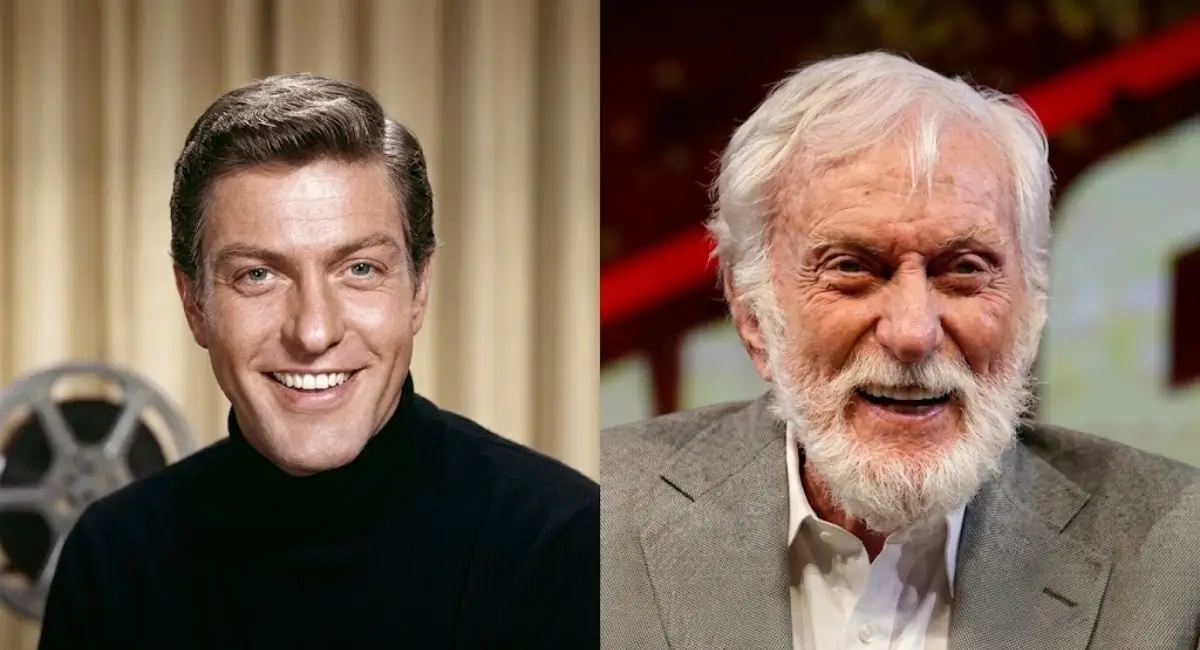
When the bright lights of mid-century television illuminated a tall, remarkably flexible performer stumbling effortlessly over a ottoman in The Dick Van Dyke Show, entertainment history changed forever. Richard Wayne Van Dyke did not merely join the ranks of American show business—he redefined what it meant to be an all-around entertainer.
Across a career spanning over seven decades, Dick Van Dyke has captivated generations as an actor, comedian, singer, dancer, and vibrant icon of pure optimism. Yet behind the dazzling smile, the iconic physical comedy, and the timeless roles in Mary Poppins and Chitty Chitty Bang Bang, lies a complex narrative of resilience, reinvention, and personal triumph. This is the untold story of how a small-town Midwestern boy became an enduring Hollywood legend.
Early Life: The Roots of a Natural Entertainer
Born on December 11, 1925, in West Plains, Missouri, and raised in Danville, Illinois, Dick Van Dyke grew up far removed from the glitz and glamour of Los Angeles. Raised during the height of the Great Depression by his mother, Hazel, and father, Loren—a traveling salesman—young Dick discovered early on that laughter was a powerful currency.
During his youth in Danville, Van Dyke was drawn to the world of performing. He drew early inspiration from silent film legends like Stan Laurel and Buster Keaton, whose hyper-expressive visual comedy would later become the bedrock of Van Dyke’s own signature style. Interestingly, acting was not his first intended path; as a teenager, he seriously considered entering the ministry. However, high school drama classes and local radio hosting duties solidified his true calling.
During World War II, Van Dyke enlisted in the United States Army Air Forces. While he served as a radio announcer and entertainer for the troops, the war years instilled in him a deep discipline and an urgency to pursue his artistic dreams once peace returned.
The Breakthrough: From Radio Pantomime to Broadway Stardom
The road to stardom was neither instant nor easy. After his military service, Van Dyke teamed up with friend Phil Erickson to form a pantomime comedy duo known as “The Eric and Van—Merry Mutes.” Touring nightclubs and small venues across the country, the pair honed their visual timing, performing silent routines synced to popular records.
By the late 1950s, Van Dyke had transitioned to television hosting and guest appearances, but his monumental breakthrough occurred on the theatrical stage. In 1960, despite having minimal formal dance training, he auditioned for a new Broadway musical titled Bye Bye Birdie.
His charismatic performance as the upbeat songwriter Albert Peterson stole the show. Critics marvelled at his effortless stage presence and uncanny physical dexterity. The role earned Van Dyke a Tony Award for Best Featured Actor in a Musical, officially putting Hollywood on notice.
The Golden Era: Television Supremacy and Cinematic Magic
The Dick Van Dyke Show (1961–1966)
In 1961, writer and producer Carl Reiner was looking for the ideal lead actor for a semi-autobiographical sitcom about a comedy writer balancing work and suburban family life. Reiner cast Van Dyke as Rob Petrie alongside a young Mary Tyler Moore as his wife, Laura.
The Dick Van Dyke Show became a landmark achievement in American television. Van Dyke’s physical slapstick—whether tripping over living room furniture or executing intricate musical numbers—was matched by sharp, witty writing. The show won 15 Emmy Awards during its five-season run, with Van Dyke taking home three Primetime Emmys for Outstanding Continued Performance by an Actor in a Leading Role. The series set the gold standard for modern television sitcoms.
+————————————————————————-+
| Key Milestones of a Legendary Career |
+——————-+—————————————————–+
| 1961 | Wins Tony Award for Broadway’s “Bye Bye Birdie” |
| 1961–1966 | Stars in the landmark “The Dick Van Dyke Show” |
| 1964 | Plays Bert and Mr. Dawes Sr. in Disney’s “Mary |
| | Poppins,” winning a Grammy Award |
| 1968 | Stars as Caractacus Potts in “Chitty Chitty Bang |
| | Bang” |
| 1993–2001 | Leads hit crime-drama series “Diagnosis: Murder” |
| 1995 | Inducted into the Television Hall of Fame |
| 2013 | Receives SAG Life Achievement Award |
| 2021 | Named a Kennedy Center Honoree |
+——————-+—————————————————–+
Disney Magic and Global Stardom
If television made him a household name, film catapulted Dick Van Dyke into international immortality. In 1964, Walt Disney cast him in the groundbreaking musical fantasy Mary Poppins, opposite Julie Andrews.
Playing the dual roles of Bert the chimney sweep and the elderly banker Mr. Dawes Sr., Van Dyke displayed boundless energy. Numbers like “Step in Time” and “Jolly Holiday” remain masterclasses in musical cinema. While critics occasionally poked fun at his exaggerated Cockney accent, his charm was undeniable. The soundtrack won a Grammy Award, and the film became a cultural phenomenon.
Four years later, Van Dyke solidified his status as a family-film icon starring as the quirky inventor Caractacus Potts in Chitty Chitty Bang Bang (1968), based on the story by Ian Fleming. His ability to connect with audiences of all ages was now world-renowned.
Behind the Smile: Personal Struggles and Triumph Over Adversity
While the public saw a man who radiated endless joy, Van Dyke’s personal life faced quiet, profound battles. For decades, he struggled with a private addiction to alcoholism.
During the 1960s and 1970s—at the height of his career—he found himself relying heavily on alcohol to cope with stress and internal pressure. In an era when public figures rarely spoke about mental health or addiction, Van Dyke made the courageous decision to seek treatment.
In 1974, he publicly checked into a hospital for alcoholism, becoming one of the first major Hollywood celebrities to speak openly about his addiction. By breaking the stigma surrounding recovery, he saved countless lives and helped shift the public conversation around sobriety.
His journey was also marked by personal loss and deep reflection, yet Van Dyke approached his recovery with the same determination he brought to the stage. His openness about his flaws made him all the more beloved by fans worldwide.
Later Career: Television Reinvention and Continued Passion
Far from retiring in his later years, Van Dyke continually reinvented his career. In the 1990s, he introduced himself to a new generation of viewers by starring as Dr. Mark Sloan in the long-running crime drama Diagnosis: Murder (1993–2001). The series showcased his dramatic versatility while allowing him to share the screen with his real-life son, Barry Van Dyke.
Even as he entered his 80s and 90s, Van Dyke refused to slow down:
- Film Cameos: He made a memorable appearance in the 2006 blockbuster Night at the Museum alongside Ben Stiller.
- Return to Disney: In 2018’s Mary Poppins Returns, a 92-year-old Van Dyke brought audiences to tears by tap-dancing on a desk as Mr. Dawes Jr., proving his remarkable agility had not diminished.
- Television Milestones: In 2023, at age 97, he performed on The Masked Singer, becoming the oldest contestant in the show’s history and leaving judges and viewers in awe.
Secrets to Longevity and the Legacy of Joy
When asked about the secret to his extraordinary longevity and youthful vitality well into his late nineties, Dick Van Dyke’s answer is characteristically simple: Keep moving.
A lifelong advocate for physical fitness, Van Dyke continues to exercise daily, sing, and stay engaged with his craft. His marriage to makeup artist Arlene Silver in 2012 brought renewed joy and creative energy to his later years, with the pair frequently sharing music and dance videos that go viral across modern social media platforms.
Beyond the awards, the star on the Hollywood Walk of Fame, and the Kennedy Center Honor, Dick Van Dyke’s true legacy lies in the spirit of his work. In a world often weighed down by cynicism, his talent stands as a testament to the power of pure, unadulterated joy. He transformed physical comedy into fine art and proved that a smile, delivered with authenticity, can echo across generations.
Dick Van Dyke remains not just a national treasure, but a living reminder of Hollywood’s golden age—a legend whose light continues to shine as brightly today as it did when he first stepped onto the screen.