
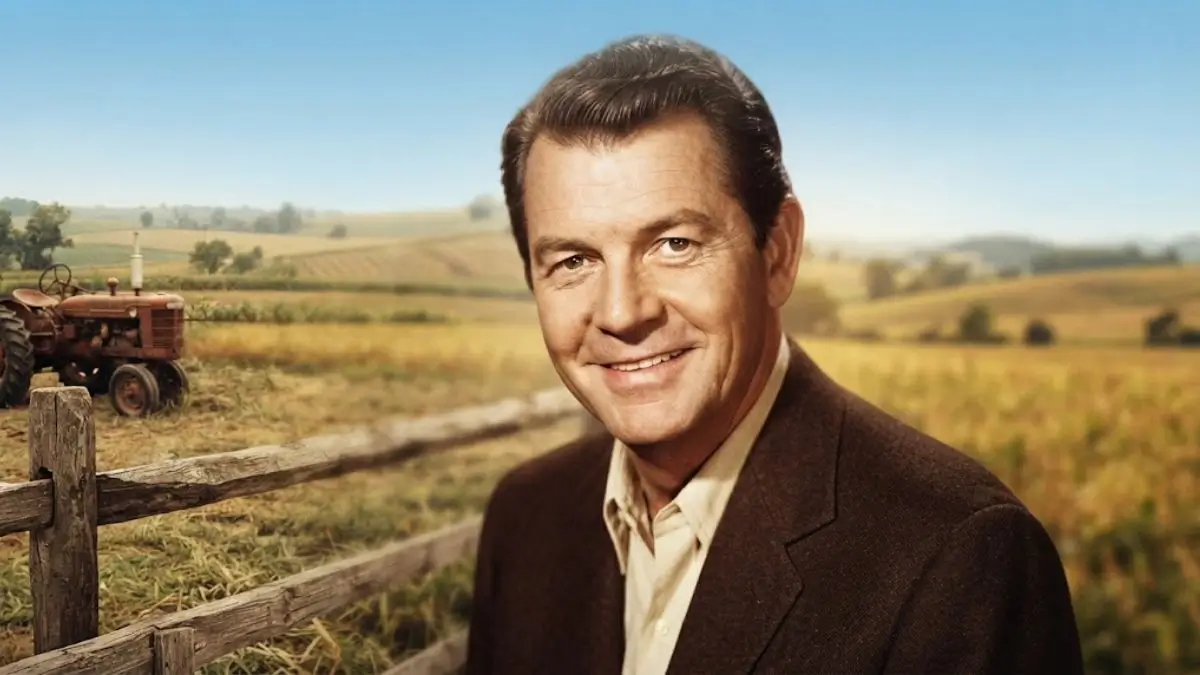
Few figures in the history of entertainment possessed the incredible range, depth, and genuine real-life heroism of Eddie Albert. Best remembered by television audiences as the quintessential city-slicker-turned-farmer Oliver Wendell Douglas in the smash-hit 1960s sitcom Green Acres, Albert’s career spanned nearly seven decades. He was a two-time Academy Award nominee, a Broadway star, an early television pioneer, an environmental activist, and a decorated World War II combat veteran who saved scores of lives under heavy fire.
Early Life and Varied Beginnings
Born Edward Albert Heimberger on April 22, 1906, in Rock Island, Illinois, Albert was the oldest of five children. When he was a toddler, his family relocated to Minneapolis, Minnesota, where he experienced an industrious and sometimes challenging childhood. He began working at the tender age of six as a newspaper delivery boy. During World War I, he faced harsh taunts from classmates who targeted him as “the enemy” because of his German surname—a burden that prompted him to eventually drop “Heimberger” professionally to avoid constant mispronunciations (such as people mistaking it for “Hamburger”).
After graduating from Central High School—where he actively participated in the drama club—Albert entered the University of Minnesota to study business. He graduated just as the catastrophic stock market crash of 1929 upended the American economy. Left largely unemployed by the Great Depression, Albert demonstrated a resilient hustle that would define his entire life. He took on an eclectic array of jobs to survive, working as an insurance salesman, a nightclub singer, and even a circus trapeze and high-wire artist. These colorful pre-fame experiences later fed directly into his remarkable stage presence and physical versatility as an actor.
Transition to Broadway and Television Pioneering
By 1933, Albert had moved to New York City, where he co-hosted a radio program titled The Honeymooners – Grace and Eddie Show. The radio gig helped him break into the thriving New York theater scene. Throughout the mid-to-late 1930s, he built a stellar reputation on Broadway, starring in hit productions like Brother Rat (1936) and Room Service (1937–1938).
Remarkably, Albert was also at the cutting edge of a brand-new medium: television. In November 1936, he participated in one of RCA’s very first live public television broadcasts. He even wrote and starred in The Love Nest, widely recognized as one of the earliest television plays ever produced. His effortless charm on stage caught the attention of Hollywood scouts, leading to a film contract with Warner Bros. and his feature film debut reprising his role in Brother Rat (1938) alongside a young Ronald Reagan.
World War II Heroism: The Battle of Tarawa
Long before his face became a staple of American television screens, Eddie Albert’s life took a profoundly courageous turn during World War II. Prior to the United States’ formal entry into the war, while touring Mexico as a circus clown and high-wire performer, Albert was secretly cooperating with U.S. Army intelligence, photographing German U-boats harbored in Mexican waters.
In 1942, he officially enlisted in the United States Coast Guard, later transferring to the U.S. Naval Reserve as a lieutenant. His ultimate test of valor came in November 1943 during the horrific and brutally contested Battle of Tarawa in the Pacific Theater.
As a landing craft commander, Albert was tasked with initial waves of operations. However, treacherous coral reefs prevented boats from reaching the shore, forcing Marines to wade hundreds of yards through open water under murderous Japanese machine-gun fire. Disregarding direct orders to focus purely on equipment salvage, Albert courageously steered his craft directly into the line of fire time and time again. He personally pulled 47 wounded and drowning Marines from the surf, while overseeing the rescue of roughly 30 others.
For his extraordinary heroism and disregard for his own safety, Albert was awarded the Bronze Star Medal with a “V” device for valor. Despite his immense success in Hollywood later in life, Albert frequently stated that his service at Tarawa was the achievement he was most proud of.
Iconic Movies and Academy Award Nominations
Returning to civilian life and acting after the war, Albert cemented his status as one of Hollywood’s most reliable, versatile character actors. He transitioned seamlessly between drama, musical comedy, and gritty westerns.
Roman Holiday (1953)
Albert delivered a career-defining performance as Irving Radovich, the happy-go-lucky press photographer companion to Gregory Peck’s reporter, who inadvertently helps a runaway European princess (Audrey Hepburn) experience normal life in Rome. The film was a critical and commercial phenomenon, earning ten Academy Award nominations. For his witty and warm supporting performance, Albert earned his first Academy Award nomination for Best Supporting Actor.
Oklahoma! (1955)
Showcasing his musical talents, Albert starred as the slippery, comedic Persian peddler Ali Hakim in the beloved film adaptation of Rodgers and Hammerstein’s Oklahoma! His natural comedic timing added vibrant energy to the classic cinematic musical.
The Heartbreak Kid (1972)
Nearly two decades after his first Oscar nod, Albert proved his dramatic range had only deepened. In Elaine May’s dark comedy The Heartbreak Kid, he played Mr. Corcoran, the fiercely protective and skeptical father of a bride whose new husband immediately falls for someone else on their honeymoon. His brilliant performance earned him his second Academy Award nomination for Best Supporting Actor.
Other Notable Film Roles
Albert’s expansive filmography includes memorable turns in:
- Brother Rat (1938)
- You Gotta Stay Happy (1948)
- The Longest Yard (1974), where he played the chillingly corrupt prison warden
- Escape to Witch Mountain (1975)
Television Immortality: Green Acres
While Albert was a respected fixture of the silver screen, television audiences around the world fell permanently in love with him through his starring role in the CBS sitcom Green Acres (1965–1971).
Playing Oliver Wendell Douglas—a successful, high-brow New York City attorney who abruptly trades his upscale lifestyle to pursue his eccentric dream of becoming a dirt farmer in the surreal, rural farming community of Hooterville—Albert played the ultimate straight man to Eva Gabor’s glamorous, Manhattan-accustomed wife, Lisa. The show’s unique blend of absurdism, sharp satire, and warm chemistry made it a legendary staple of 1960s television, and it remains heavily syndicated globally today.
Following Green Acres, Albert continued to command the small screen, starring as police investigator Frank MacBride in the 1970s crime drama Switch (alongside Robert Wagner) and taking on recurring roles in prime-time soap operas like Falcon Crest.
Humanitarianism, Environmentalism, and Personal Life
Away from the studio lights, Eddie Albert was an impassioned advocate for social and environmental causes long before “going green” became mainstream. An avid organic gardener and nature lover, he spent decades championing ecological preservation, soil conservation, and clean water initiatives. He worked closely with organizations like Boy Scouts of America and various environmental groups, lending his celebrity voice to sustainable agricultural practices and urban tree-planting campaigns.
Albert was married to actress Margo (Maria Margarita Guadalupe Boldt y Castilla) from 1945 until her death in 1985. The couple had a son, actor Edward Albert Jr., and adopted a daughter, Maria. True to his humble and grounded nature throughout his life, Albert remained active well into his later years, residing in Pacific Palisades, California, until his passing on May 26, 2005, at the age of 99.
Life Legacy and Cultural Impact
Eddie Albert left behind an indelible blueprint of what a multi-faceted life in the public eye could achieve. He was never boxed into a single archetype; he moved fluidly from the high wire to the Broadway stage, from the smoke of the Pacific theater to the glitz of Hollywood, and from an Oscar-nominated dramatic heavy to a beloved television farmer.
Recognized with a star on the Hollywood Walk of Fame, Albert’s legacy endures not just through celluloid and television re-runs, but through his enduring example of integrity, artistic excellence, and quiet, unyielding courage when it mattered most.