
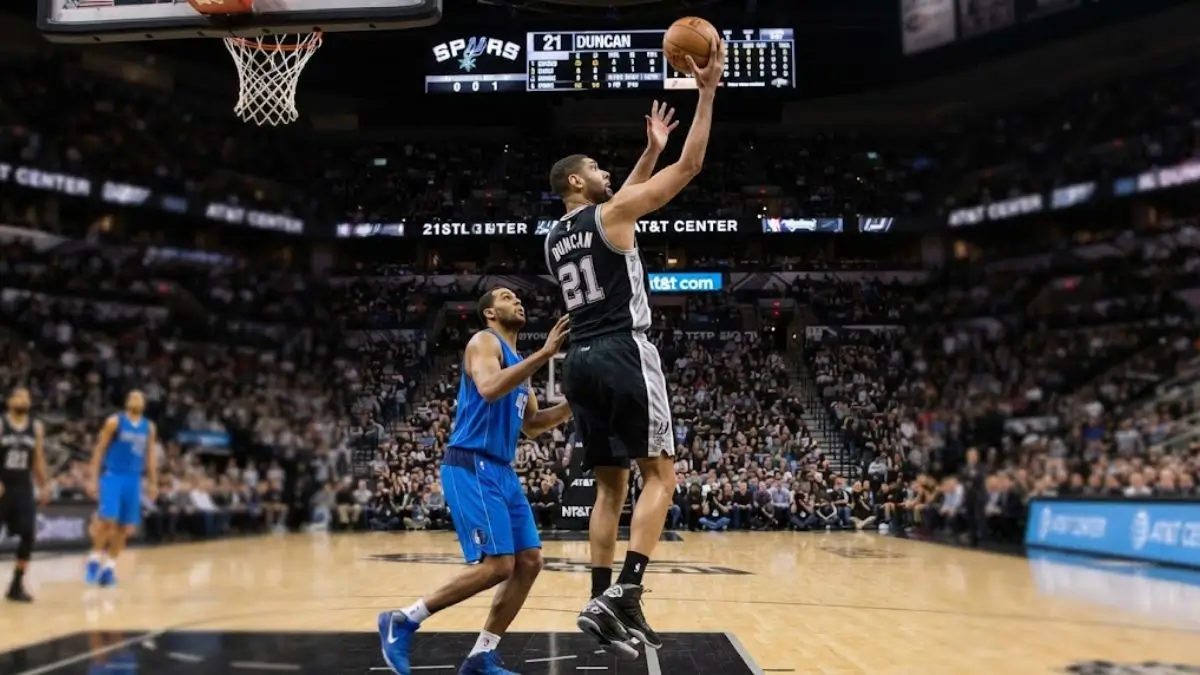
In the history of the National Basketball Association (NBA), few players have commanded as much respect while seeking as little attention as Tim Duncan. Earning the moniker “The Big Fundamental,” Duncan did not rely on flashy dunks, dramatic celebrations, or relentless self-promotion. Instead, he dismantled opponents with peerless footwork, impeccable defensive positioning, an automatic bank shot, and an unmatched basketball IQ. Over a legendary 19-year career spent entirely with the San Antonio Spurs, Duncan transformed a small-market franchise into a global dynasty, capturing five championships and redefining what it meant to be a franchise player, a consummate teammate, and a leader.
From the Waters of St. Croix to the Hardwood
Long before he dominated the paint in the NBA, Timothy Theodore Duncan’s athletic aspirations lay entirely in the water. Born and raised in Saint Croix, U.S. Virgin Islands, Duncan was a standout competitive swimmer specializing in freestyle events. He harbored legitimate dreams of competing in the Olympic Games, following in the footsteps of his older sister.
However, fate intervened in 1989 when Hurricane Hugo tore through the Virgin Islands, completely destroying the island’s only Olympic-sized swimming pool. Forced to train in the ocean, Duncan developed a profound fear of sharks, which effectively brought his swimming career to a halt. Seeking a new outlet, his brother-in-law introduced him to basketball. Though initially clumsy and raw due to his height, Duncan applied his immense discipline to the sport. By the time he enrolled at Wake Forest University, he had evolved into one of the most sought-after prospects in the country, setting the stage for a historic basketball journey.
The Wake Forest Standout and the 1997 Draft
Duncan’s college career under coach Dave Odom at Wake Forest cemented his status as a generational prospect. Displaying rare maturity, he stayed all four years to honor a promise made to his mother before her passing—that he would earn his college degree.
During his time as a Demon Deacon, Duncan was a defensive fortress and an offensive powerhouse. He won back-to-back ACC Player of the Year awards (1996, 1997) and swept national player of the year honors in 1997, capturing the prestigious John R. Wooden Award and the Naismith College Player of the Year. When he declared for the 1997 NBA Draft, there was never any doubt who would go first overall. The San Antonio Spurs, having won the lottery after an injury-plagued season, gladly selected him, instantly altering the trajectory of their franchise for the next two decades.
Building a Dynasty: The San Antonio Spurs Era
Upon entering the league, Duncan made an immediate impact, winning the 1998 NBA Rookie of the Year award and earning All-NBA First Team honors right out of the gate. Partnering with veteran center David Robinson to form the formidable “Twin Towers,” Duncan did not have to wait long for team success. In just his second season (the lockout-shortened 1998–99 campaign), he led the Spurs to their first-ever NBA Championship, capturing the NBA Finals MVP award.
As Robinson aged and eventually retired in 2003, Duncan seamlessly assumed the mantle of undisputed team leader. Alongside head coach Gregg Popovich, Duncan anchored a culture built on selflessness, defense, and execution.
The arrival of guard Tony Parker and shooting guard Manu Ginóbili formed the legendary “Big Three,” a trio that would become the winningest combination in playoff history. Together, they captured additional titles in 2003, 2005, and 2007. Duncan earned regular-season MVP awards in back-to-back seasons (2002 and 2003) and added two more Finals MVPs to his resume in 2003 and 2005.
The Longevity and the Fifth Ring
What separates Tim Duncan from almost every other legend in sports history is the longevity and consistency of his prime. As athletic ability naturally faded into his late thirties, Duncan adapted his game. He relied even more heavily on his sublime footwork, expert passing out of double-teams, and brilliant positional defense.
In 2014, years after many analysts had written off the Spurs as a fading dynasty, Duncan orchestrated a breathtaking redemption tour. Facing the Miami Heat—the very team that had heartbreakingly defeated them in the 2013 Finals—Duncan and the Spurs played a brand of beautiful, fluid basketball that many dubbed the peak of team sports. Sweeping through the playoffs with surgical precision, San Antonio captured their fifth NBA title. With this championship, Duncan joined an exclusive tier of players to win titles across three distinct decades (1999, 2003, 2005, 2007, 2014).
He played two more seasons before quietly announcing his retirement in July 2016, walking away from the game with the same unassuming grace that defined every day he spent in the public eye.
Legacy and Impact on the Game
When examining basketball history, Tim Duncan’s resume places him securely in the conversation for the top ten players of all time, and undisputedly as the greatest power forward to ever lace up sneakers. His comprehensive list of accolades includes:
- 5x NBA Champion (1999, 2003, 2005, 2007, 2014)
- 3x NBA Finals MVP
- 2x NBA Regular Season MVP (2002, 2003)
- 15x NBA All-Star
- 15x All-NBA Team Selection
- 15x NBA All-Defensive Team Selection—holding the record for the most defensive team selections in history.
- Naismith Memorial Basketball Hall of Fame Inductee (Class of 2020)
Beyond the statistics—26,496 points, 15,091 rebounds, and 3,020 blocks—Duncan changed the culture of professional sports. In an era dominated by ego and individual branding, he proved that humility, professionalism, and team-first selflessness could construct a permanent winning legacy. Even his brief stint as an assistant coach for the Spurs in the 2019–20 season underscored his ongoing dedication to nurturing the next generation.
Family Life
Away from the blinding lights of the NBA arena, Tim Duncan always maintained a deeply private personal life centered around his children and close family. He was previously married to Amy Sherrill, with whom he shares two children, daughter Sydney and son Draven, and later welcomed a daughter named Quill with his partner Vanessa Macias. Despite his immense global fame, Duncan successfully shielded his family from tabloid culture, preferring to spend his retirement years pursuing quiet hobbies like car customization, video games, and martial arts in Texas and the U.S. Virgin Islands.
4 thoughts on “Tim Duncan: The Quiet Maestro and the Greatest Power Forward of All Time”