
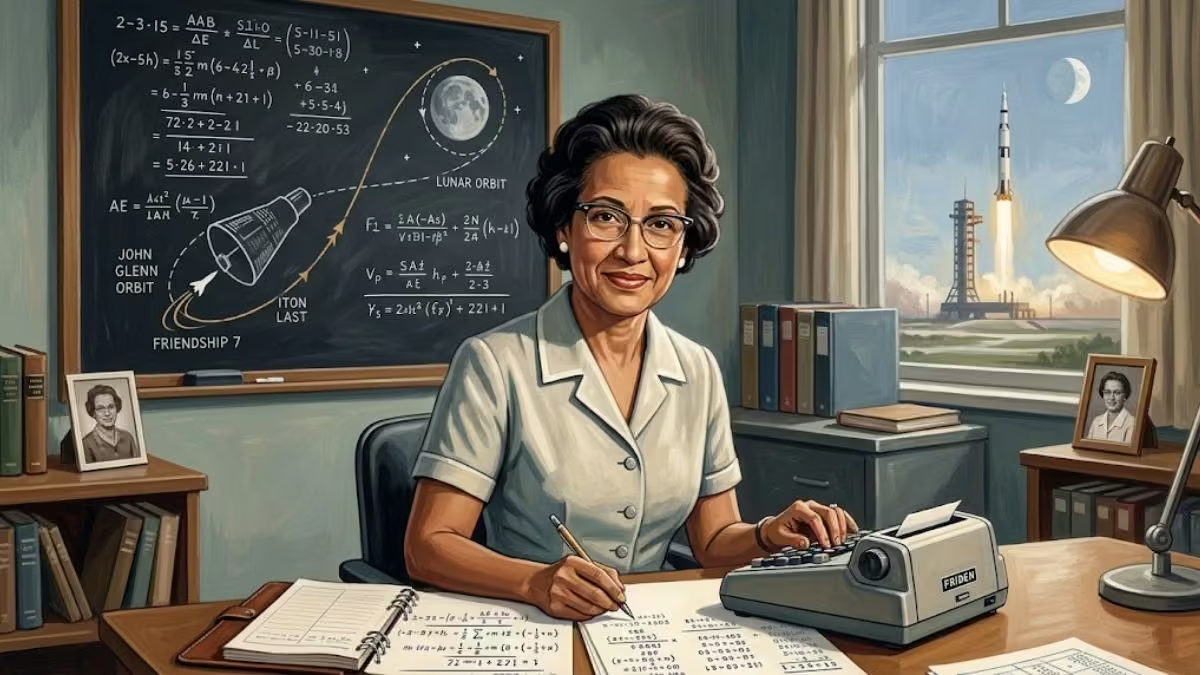
Long before digital supercomputers processed orbital mechanics in fractions of a second, the destiny of American space exploration depended on hand calculations recorded on grid paper. At the heart of this high-stakes effort stood Katherine Johnson, a brilliant African American mathematician whose precise trajectory calculations guided astronauts into space, orbited them around Earth, and safely landed them on the Moon.
For decades, her pioneering contributions remained largely obscured by societal barriers and institutional secrecy. Today, Katherine Johnson is celebrated as a key figure in space history—a visionary mathematician whose intellect broke through racial and gender ceilings during the height of the Jim Crow era and the Space Race.
Early Life and Extraordinary Mathematical Genius
Born on August 26, 1918, in White Sulphur Springs, West Virginia, Creola Katherine Coleman demonstrated an astonishing affinity for numbers at an early age. “I counted everything,” she would later recall. “I counted the steps to the road, the steps up to the church, the number of dishes and silverware I washed… anything that could be counted, I did.”
Her mathematical talent was so advanced that her local school system could no longer accommodate her. Because public high schools for African American students were unavailable in her home county, her father, Joshua Coleman, moved the family 120 miles to Institute, West Virginia, so Katherine and her siblings could attend high school on the campus of West Virginia State College.
- High School Graduation: Age 14
- College Graduation: Age 18 (Summa Cum Laude with degrees in Mathematics and French)
At West Virginia State College, Katherine found a mentor in Dr. William W. Schieffelin Claytor, the third African American to earn a Ph.D. in mathematics in the United States. Recognizing her exceptional brilliance, Dr. Claytor created custom advanced math courses specifically for her, including complex analytic geometry.
In 1939, Katherine became one of three Black students—and the first Black woman—selected to integrate the graduate school at West Virginia University following the U.S. Supreme Court ruling in Gaines v. Canada. Though she briefly pursued graduate studies, she chose to leave her program to focus on raising her three daughters with her first husband, James Goble.
Joining NACA: The West Area Computing Unit
In 1952, a family relative mentioned a rare employment opportunity: the National Advisory Committee for Aeronautics (NACA)—the predecessor to NASA—was hiring Black women with mathematics degrees at its Langley Memorial Aeronautical Laboratory in Hampton, Virginia.
During this period, federal agencies operated under strict racial segregation laws. Katherine was assigned to the West Area Computing unit, a segregated pool of African American women known collectively as the “West Computers.” Guided by leaders like Dorothy Vaughan, these mathematicians manually processed raw flight data, conducted stress analyses, and calculated complex aerodynamic equations for aircraft research.
Quick Profile Overview
| Key Metric | Details |
| Full Name | Creola Katherine Coleman Johnson |
| Born | August 26, 1918 (White Sulphur Springs, WV) |
| Died | February 24, 2020 (Aged 101) |
| Key Employers | NACA, NASA (1953–1986) |
| Famous Missions | Mercury-Redstone 3, Friendship 7, Apollo 11, Apollo 13 |
| Major Honors | Presidential Medal of Freedom (2015), Congressional Gold Medal (2019) |
Despite working under Jim Crow restrictions—including segregated restrooms and dining facilities—Katherine’s proficiency quickly distinguished her. Within months of her arrival in 1953, she was temporarily assigned to the Flight Research Division, where her temporary transfer permanently turned into a full-time position.
Breaking Barriers: From “Human Computer” to Spacecraft Analyst
When the Soviet Union launched Sputnik 1 in October 1957, the Space Race began in earnest. NACA transitioned into NASA in 1958, shifting its primary objective from aeronautics to orbital spaceflight.
Katherine Johnson stepped directly into this high-pressure environment. She insisted on attending engineering briefings—a practice previously reserved exclusively for male engineers. When told that women did not normally attend such meetings, Katherine simply asked, “Is there a law against it?”
Her persistence paid off. She joined the Space Task Group, becoming an irreplaceable asset due to her mastery of geometry, orbital trajectories, and theoretical physics.
In 1960, she made history by co-authoring a technical report titled Determination of Azimuth Angle at Burnout for Placing a Satellite Above a Selected Earth Position. Co-authored with engineer Ted Skopinski, it marked the first time a woman in the Flight Research Division received author credit on an official NASA research paper.
Historical Contributions to NASA’s Key Missions
Katherine Johnson’s calculations directly enabled the most iconic triumphs of the American space program:
1. Freedom 7 (Alan Shepard’s Flight)
On May 5, 1961, Alan Shepard became the first American in space aboard the Freedom 7 capsule. Katherine calculated the suborbital trajectory for the mission, mapping the exact launch window, velocity, and splashdown coordinates required to ensure a safe recovery.
2. Friendship 7 (John Glenn’s Orbital Mission)
By 1962, NASA was preparing to launch John Glenn into orbit around Earth, marking a critical transition to IBM electronic digital computers. However, astronauts were skeptical of the early, prone-to-glitch mainframe machines.
Before his historic flight on February 20, 1962, John Glenn famously refused to fly until Katherine manually verified the IBM computer’s orbital trajectory calculations. Glenn told mission controllers:
“Get the girl to check the numbers. If she says they’re good, then I’m ready to go.”
Katherine spent days verifying every equation by hand using a desktop mechanical calculator. Her numbers matched the computer’s output perfectly, giving Glenn the green light for America’s first successful orbital spaceflight.
3. Apollo 11 Moon Landing
Katherine’s calculations extended to humanity’s greatest space exploration achievement: the 1969 Apollo 11 mission. She helped calculate the flight trajectory that carried Neil Armstrong, Buzz Aldrin, and Michael Collins to the Moon. More crucially, her work synchronized the Lunar Module’s rendezvous with the Command Module orbiting above the lunar surface.
4. Apollo 13 Crisis Management
When an oxygen tank exploded aboard Apollo 13 in April 1970, threatening the lives of the crew, Katherine’s expertise proved vital. She contributed to backup flight procedures, contingency charts, and single-star navigation strategies that enabled the damaged spacecraft to safe-return around the Moon and land back on Earth.
Recognition, Legacy, and Hidden Figures
Katherine Johnson retired from NASA in 1986 after 33 years of service. For many years, her achievements remained mostly known within scientific circles.
That changed dramatically with the publication of Margot Lee Shetterly’s 2016 book Hidden Figures and its subsequent Oscar-nominated film adaptation, in which Katherine was portrayed by actress Taraji P. Henson. The story brought worldwide attention to Katherine Johnson, Dorothy Vaughan, Mary Jackson, and the entire community of female human computers.
Major Awards and Honors
- Presidential Medal of Freedom (2015): Awarded by President Barack Obama, the highest civilian honor in the United States.
- NASA Computational Research Facility (2017): NASA dedicated the Katherine G. Johnson Computational Research Center at Langley Research Center in her honor.
- Congressional Gold Medal (2019): Awarded by the U.S. Congress to recognize her historic service.
- Statue & Scholarship (2018): Dedicated at her alma mater, West Virginia State University.
Katherine Johnson passed away on February 24, 2020, at the age of 101. Her legacy continues to inspire generations of young people—particularly young women and minority students—to pursue careers in science, technology, engineering, and mathematics (STEM).
Key Takeaways: Why Katherine Johnson’s Legacy Matters
- Pioneered Space Trajectories: Calculated critical paths for America’s first human spaceflights, orbital missions, and the Apollo Moon landings.
- Shattered Social Barriers: Overcame systemic racism and sexism in federal employment during the Jim Crow era.
- Pioneered STEM Inclusivity: Proved that precision, intellect, and relentless curiosity outweigh prejudice.
Katherine Johnson proved that mathematics is not merely a tool for solving equations—it is a language capable of expanding human potential beyond the boundaries of Earth.


2 thoughts on “Katherine Johnson Biography: The Untold Story of NASA’s Human Computer”